


One of the most notorious moments in F1 history happened 20 years ago today.
Ayrton Senna clinched the 1990 world championship in a deeply controversial Japanese Grand Prix. He rammed into rival Alain Prost at the first corner at Suzuka, taking both of them out of the race.For the third year in a row F1 arrived in Japan with the same two drivers in the thick of the championship fight: Ayrton Senna and Alain Prost. Once again, Suzuka decided the outcome of their personal battle.
Senna claimed the 51st pole position of his career, a feat that was central to the weekend’s controversy. Pole position at Suzuka had been on the right-hand side of the track – off the racing line – for each of the three previous F1 races at the track.
Senna had started there in 1988, bogged down badly, fallen to 14th, yet recovered to win the race and the drivers’ title.
He started there again in 1989 and as he struggled for grip at the start Prost charged into the lead from second place. Senna caught and tried to pass his rival at the chicane later in the race, but Prost swerved into the side of Senna’s car, taking both out, denying Senna the championship.
Before qualifying for the 1990 race had even begun, Senna lobbied track officials for pole position to be moved to the left and onto the racing line. He believed he’d got their consent – but after claiming pole position he was told he would start from the right-hand side of the track once again.
Senna saw the hand of FISA president Jean-Marie Balestre in the decision. The same person he blamed for his disqualification from the 1989 race, after he had disentangled his car from Prost’s and driven through the run-off at the chicane to re-join the track.
Advert | Become a RaceFans supporter and
In the drivers’ briefing before the 1990 race the drivers were told they would not be disqualified for using the run-off at the chicane, as Senna had 12 months previously. He stormed out of the room:
1990 Japanese Grand Prix grid
| Row 1 | 1. Ayrton Senna 1’36.996 McLaren-Honda | |
| 2. Alain Prost 1’37.228 Ferrari | ||
| Row 2 | 3. Nigel Mansell 1’37.719 Ferrari | |
| 4. Gerhard Berger 1’38.118 McLaren-Honda | ||
| Row 3 | 5. Thierry Boutsen 1’39.324 Williams-Renault | |
| 6. Nelson Piquet 1’40.049 Benetton-Ford | ||
| Row 4 | 7. Riccardo Patrese 1’40.355 Williams-Renault | |
| 8. Roberto Moreno 1’40.579 Benetton-Ford | ||
| Row 5 | 9. Aguri Suzuki 1’40.888 Lola-Lamborghini | |
| 10. Pierluigi Martini 1’40.899 Minardi-Ford | ||
| Row 6 | 11. Derek Warwick 1’41.024 Lotus-Lamborghini | |
| 12. Ivan Capelli 1’41.033 Leyton House-Judd | ||
| Row 7 | 13. Satoru Nakajima 1’41.078 Tyrrell-Ford | |
| 14. Johnny Herbert 1’41.588 Lotus-Lamborghini | ||
| Row 8 | 15. Mauricio Gugelmin 1’41.698 Leyton House-Judd | |
| 16. Eric Bernard 1’41.709 Lola-Lamborghini | ||
| Row 9 | 17. Nicola Larini 1’42.339 Ligier-Ford | |
| 18. Emanuele Pirro 1’42.361 Dallara-Ford | ||
| Row 10 | 19. Gianni Morbidelli 1’42.364 Minardi-Ford | |
| 20. Philippe Alliot 1’42.593 Ligier-Ford | ||
| Row 11 | 21. Stefano Modena 1’42.617 Brabham-Judd | |
| 22. David Brabham 1’43.156 Brabham-Judd | ||
| Row 12 | 23. Alex Caffi 1’43.270 Arrows-Ford | |
| 24. Michele Alboreto 1’43.304 Arrows-Ford | ||
| Row 13 | 25. Andrea de Cesaris 1’43.601 Dallara-Ford |
Jean Alesi, Tyrrell-Ford, qualified seventh but withdrew from the race weekend due to injuries sustained in an accident during practice.
Did not qualify
14. Olivier Grouillard, Osella-Ford – 1’43.782
17. Gabriele Tarquini, AGS-Ford – 1’44.281
18. Yannick Dalmas, AGS-Ford – 1’44.410
31. Bertrand Gachot, Coloni-Ford – 1’45.393
Over in nine seconds
As the race started Prost instantly pulled ahead of Senna and into the lead. Senna briefly tucked in behind his rival.
Turn one came up on them quickly. Prost moved towards the middle of the track, then feinted back to the left as Senna lined himself up for a look at the inside.
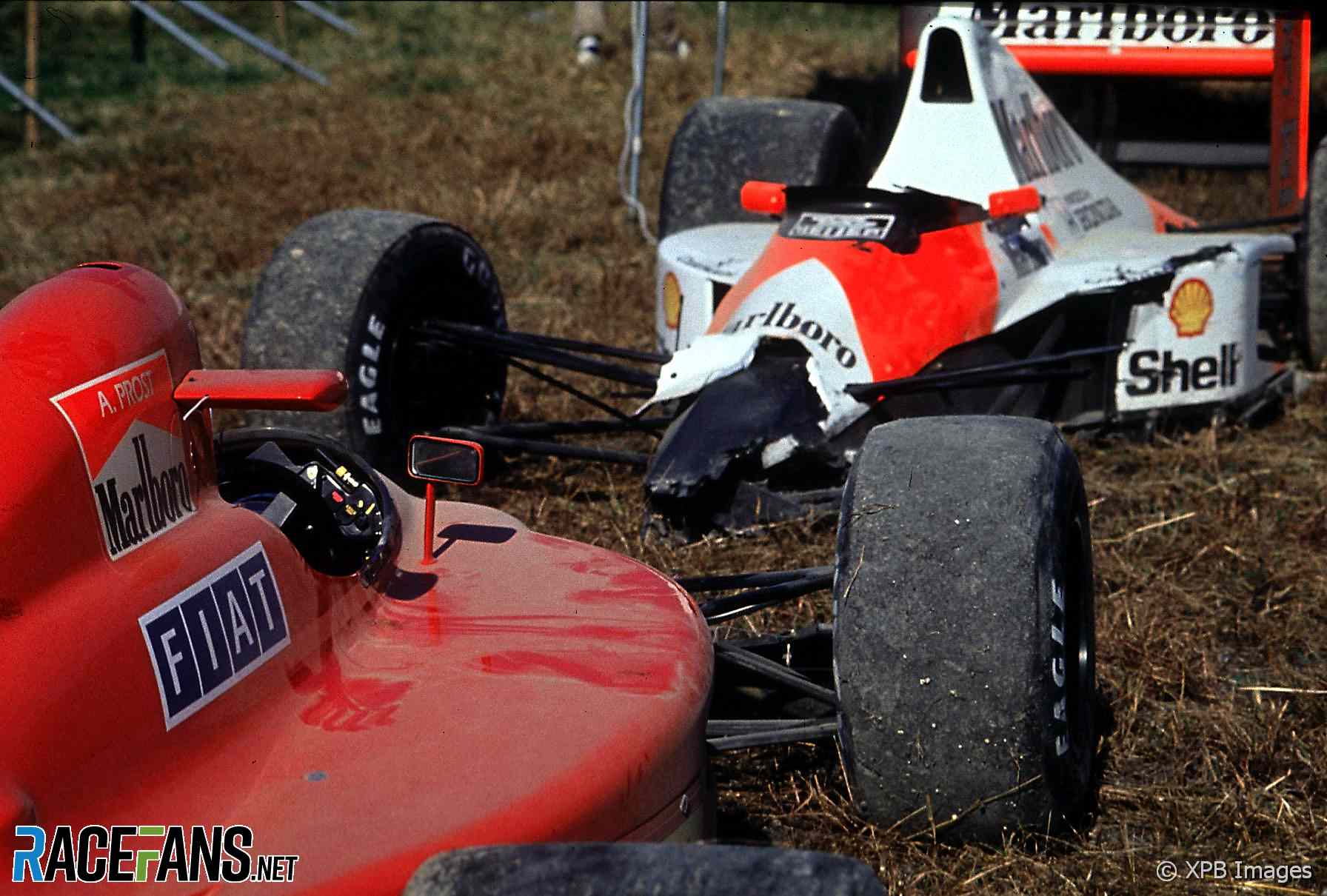
Prost lifted the throttle and turned into the corner. Senna slammed into his right-rear wheel at a speed of no less than 130mph, probably much higher.
The two wrecked cars hurtled into the gravel trap where they were briefly obscured by a cloud of grit. As the dust settled two figures climbed from their cars and made their way back to the pits separately.
Senna asked: “They’re not stopping the race, are they?” and was told they weren’t. With that, he was the 1990 world champion.
A race to forget
As lap two started the other McLaren of Gerhard Berger joined Senna’s in the gravel trap at turn one. Berger, who had inherited the lead, slid sideways off the track and out of the race.
That promoted Nigel Mansell into the lead. He ran around at the head of the field unchallenged for the first half of the race, gradually leaving Nelson Piquet’s Benetton behind.
The only prospect of a competition for the lead arose from the fact that Mansell would have to change tyres and Piquet, who had started on a harder compound, wouldn’t (there was no requirement to use two compounds of tyre during a race then).
But Mansell never made it out of the pits after coming in on lap 27. Once again, the Ferrari’s semi-automatic transmission let him down.
His ninth retirement from 15 starts ended Ferrari’s hopes of winning the constructors’ championship. For the third consecutive season the trophy went to McLaren.
Advert | Become a RaceFans supporter and
Piquet now held an unchallenged lead. Alesi, who had been due to start behind the Benetton driver, was left to wonder what might have been.
Behind Piquet was his new team mate Roberto Moreno, who had been drafted into Benetton after Alessandro Nannini lost his arm in a helicopter accident.
Moreno had spent the year up to that point campaigning the hopeless EuroBrun, qualifying just twice in 14 attempts, and admitted it had been quite an adjustment to get used to the higher levels of downforce the B190 offered.
The Brazilian driver wept after taking the chequered flag behind his compatriot. Piquet’s victory ended his own three-year win drought and headed Benetton’s first one-two.
The early demise of the two Honda-powered cars did not end local interest in the race. Aguri Suzuki took the final podium place, the first Japanese driver ever to finish in the top three in a world championship event.
The Lola driver used his extensive local knowledge of Suzuka to qualify ninth on the grid. He picked off Derek Warwick early in the race and, running to the end without making a pit stop, inherited places from both the Williams drivers to claim third.
Satoru Nakajima made it two Japanese drivers in the points by bringing his Tyrrell home sixth.
1990 Japanese Grand Prix result
| Pos | Car | Driver | Team | Laps | Difference |
| 1 | 20 | Nelson Piquet | Benetton-Ford | 53 | |
| 2 | 19 | Roberto Moreno | Benetton-Ford | 53 | 7.223 |
| 3 | 30 | Aguri Suzuki | Lola-Lamborghini | 53 | 22.469 |
| 4 | 6 | Riccardo Patrese | Williams-Renault | 53 | 36.258 |
| 5 | 5 | Thierry Boutsen | Williams-Renault | 53 | 46.884 |
| 6 | 3 | Satoru Nakajima | Tyrrell-Ford | 53 | 1’12.350 |
| 7 | 25 | Nicola Larini | Ligier-Ford | 52 | 1 Lap |
| 8 | 23 | Pierluigi Martini | Minardi-Ford | 52 | 1 Lap |
| 9 | 10 | Alex Caffi | Arrows-Ford | 52 | 1 Lap |
| 10 | 26 | Philippe Alliot | Ligier-Ford | 52 | 1 Lap |
| 11 | Derek Warwick | Lotus-Lamborghini | 38 | ||
| 12 | Johnny Herbert | Lotus-Lamborghini | 31 | ||
| 9 | Michele Alboreto | Arrows-Ford | 28 | ||
| 2 | Nigel Mansell | Ferrari | 26 | ||
| 21 | Emanuele Pirro | Dallara-Ford | 24 | ||
| 29 | Eric Bernard | Lola-Lamborghini | 24 | ||
| 24 | Gianni Morbidelli | Minardi-Ford | 18 | ||
| 16 | Ivan Capelli | Leyton House-Judd | 16 | ||
| 22 | Andrea de Cesaris | Dallara-Ford | 13 | ||
| 15 | Mauricio Gugelmin | Leyton House-Judd | 5 | ||
| 7 | David Brabham | Brabham-Judd | 2 | ||
| 28 | Gerhard Berger | McLaren-Honda | 1 | ||
| 27 | Ayrton Senna | McLaren-Honda | 0 | ||
| 1 | Alain Prost | Ferrari | 0 |
The aftermath of the crash
What drove Senna to commit one of the most outrageous acts ever witnessed in Formula 1? His frustration with the sport’s governing body – Balestre the focus of his fury – combined with a growing sense of desperation that the championship was slipping away from him.
The Ferrari F1-90 had clearly been quicker than the McLaren MP4-5B in the previous two races.
Senna knew he had been fortunate to take points off Prost at Estoril. At Jerez Prost had out-manoeuvred Senna in the pits, driven away from him on the track, and to make matters worse a damaged radiator left Senna point-less.
Heading into the two remaining races Senna had a nine-point lead over Prost in the championship. There were nine points available for a win, then 6-4-3-2-1 for the remaining places, but drivers could only count their 11 best scores, making the situation more complicated.
It’s likely two things were weighing on Senna’s mind: if Prost won both the remaining races, there was nothing Senna could do to stop him from being champion.
But if Prost failed to finish one of the remaining races, Senna would definitely be champion.
It’s not hard to imagine how the row over the location of pole position affected Senna’s state of mind. As he walked back to the pits following the crash he told reporters that was the reason why the collision had happened.
When F1 returned to Suzuka in 1991 pole position had been moved to the left-hand side of the track. Senna won his third world championship that weekend, and in the press conference afterwards launched into a tirade against Balestre:
I said to myself, “OK, you try to work cleanly, and you get ****** by certain people. All right, if tomorrow Prost beats me off the line, at the first corner, I will go for it and he better not turn in because he’s not going to make it.” And it just happened.
Ayrton Senna
Following the Suzuka collision in 1990 a furious Balestre told the world:
It is a scandal that a world championship should be decided on such a collision and I leave everyone to be their own judge of who is to blame.
Jean-Marie Balestre
It’s true that what Senna did to Prost in 1990 only differed to what Prost did to Senna in 1989 by degrees. In principle, Prost’s actions were every bit as cynical as Senna’s.
And by allowing Prost to go unpunished after taking Senna out of the 1989 title-decider, what could FISA do about Senna in 1990? According to Balestre, nothing:
Last year the race stewards disqualified Senna because he cut short a chicane. This time, they told me on the telephone, that there were no elements to allow Senna’s disqualification.
Jean-Marie Balestre
Go ad-free for just £1 per month
>> Find out more and sign up
The governing body’s failure to act against a championship-deciding crash in 1989 left them powerless in 1990.
More followed in later years, courtesy of Michael Schumacher, in 1994 and (unsuccessfully) again in 1997. Since then Balestre’s successor Max Mosley has suggested the FIA would step in were it to happen again but that has not yet been put to the test.
The extreme tactics Senna was prepared to used to win the world championship – risking his own life as well as Prost’s and potentially others’ – was not lost on his arch-rival, who said:
I’m not prepared to fight against irresponsible people who are not afraid to die.
Alain Prost
The horrendous consequences which Senna’s actions could have had were demonstrated in a tragic crash two years later.
Hitoshi Ogawa and Andrew Gilbert-Scott collided at the same corner during a Japanese Formula 3000 race in 1992, at comparable speeds to Senna and Prost, perhaps a shade higher.
Ogawa was killed when his car was launched over the barrier. Gilbert-Scott, a cameraman and two photographers were also injured.
On many other days Senna’s otherworldly driving ability – not to mention his intense personal charisma – won him legions of supporters. His greatest drives have inspired a further generation of fans since his death.
But there was a dark side to his character which the events of October 21st 1990 make impossible to ignore.
His life is the subject of a new film documentary, already released in Japan, which is due to open in many other countries next year. Surely the most difficult chapter of his life to relate is the actions that made him the 1990 world champion.
Did you see this race?
Were you at the 1990 Japanese Grand Prix? Did you watch it live? If so, please tell us about it in the comments.
Grand Prix flashback
- Schumacher seals record-breaking 10th constructors championship for Ferrari
- Strategic superiority clinches Schumacher’s first Ferrari title
- Disaster for Hakkinen brings title within Schumacher’s grasp
- Schumacher turns the tide against McLaren on tragic day at Monza
- Hakkinen stuns Schumacher with three-wide pass for fourth win

Cesar
21st October 2010, 0:36
Great article Keith.
Unfortunately, I think Formula 1 has not learn the biggest lesson of the 1989, 1990 incident, let me explain.
1989 shown all the F1 fanatics that there was a lot of politics in the series (even more than any other sport) and that never helps because drivers and fans wants the drivers to decide the race and titles in the track, not in the offices with lawyers and phone calls.
Unfortunatelly after 1989 aftermath, Senna decided to give it all and win whatever in takes, even risking his own life. You can see that in MS 1st championship or 1997 collision with Villenueve. Also in 2003 Ferrari`s championship with the “last minute” ban of Michellin tyres, etc.
The sport can`t reach the glory of 1980s and that`s not a problem regarding the drivers or teams, is most related to the politics that are killing it.
spectator
21st October 2010, 0:49
Cesar the 03 “last minute” ban should have been made long time ago anyway i agree with you despite that there a lot of people that still watch f1 believing that f1 is a sport and its driven by drivers and than by teams but that isnt the truth f1 is a show like any other and if we were going to let it by it self it would have already been “canceled”
DamionShadows (@damionshadows)
21st October 2010, 0:36
This page is getting bookmarked. For someone who’s been watching F1 for only 3 years, it’s nice to read such a detailed and thorough article on one of the most controversial incidents in Formula 1!
Keith Collantine (@keithcollantine)
21st October 2010, 8:57
Cheers Damion! Check out the other ‘Flashbacks’ in the links at the bottom of the article for more.
David-A (@david-a)
21st October 2010, 0:43
Two Japanese drivers in the points? In the same race? Not just the same decade? :P
Keith Collantine (@keithcollantine)
21st October 2010, 8:57
I was wondering how many other times that’s happened. Anyone know?
BasCB
21st October 2010, 12:56
It was close last year before Nakajima flew over Kobayashi’s rear wheel, but i suppose it might have happened again in he 90’s?
RobertG
21st October 2010, 15:32
i think never ever after and b4. anyway this http://statsf1.com/en/japan/pilote.aspx can help
slr
21st October 2010, 17:00
Both Nakajima and Suzuki finished 5th and 6th respectively at the 1991 US Grand Prix, thus both drivers scoring points.
Keith Collantine (@keithcollantine)
21st October 2010, 17:06
Top knowledge!
Hare (@hare)
21st October 2010, 1:10
Curious, because Senna kept his foot in and Prost shut the door… Kind of similar in principle if not actual events to Webber and Hamilton.
spectator
22nd October 2010, 1:36
you were watching the wrong car prost did the usual trajectory senna planned that and i dont blame him
Alexi (@)
21st October 2010, 1:11
Ah, back in the days of ruthless motivation.I wonder how many drivers would dare such a move nowadays to win the title – Schumacher and Alonso for sure, Vettel probably and Hamilton could try it out of desperation but considering his present luck and how soft his McLaren is the move would likely backfire. All of this supposing there would be no ban after.
Fer no.65 (@fer-no65)
21st October 2010, 1:16
Love the brakes going red @1:00, while braking for Spoon!
judo chop
21st October 2010, 2:51
I used to be a Senna fanboy and make every excuse for that crash but looking back I now consider it worse than anything Schumacher did. Senna was so reckless that he tore off his own front wing before he even made contact with Prost.
Todfod (@todfod)
21st October 2010, 8:55
You obviously missed Adelaide 94, where after wrecking his car Schumacher gets back on track just to take Damon hill out. I agree that Senna was no saint, but this was a move just in retaliation to what happened the previous year. Schumacher’s moves in 1994 and 1997 were inexcusable.
Keith Collantine (@keithcollantine)
21st October 2010, 8:56
Schumacher’s were less dangerous than this one, surely?
David B
21st October 2010, 9:08
Schumi at Jerez ’97 did exactly what Prost did at Suzuka ’89. And Senna in the ’90 did something Schumi has never done…
I think what Senna and Prost did to each other was not fairer at all than Schumi moves. But Schumi has been generally blamed, with too much severity.
Daniel
21st October 2010, 11:31
Sorry, still can’t agree that ’94 was a take out. I’ve watched it many times. Schumacher, makes an error them moves back to cover the racing line, he can’t yet know if his car is broken or not. Hill went for a gap that wasn’t completely there, if he’d waited Schumacher’s car might have been broken, but he can’t be sure either, so he goes for the gap. It’s a racing accident.
Keith Collantine (@keithcollantine)
21st October 2010, 11:35
After Jerez ’97 I can’t believe anyone still takes Adelaide ’94 at face value.
Daniel
21st October 2010, 12:11
They are two separate incidents. I always try and judge each situation on its merits.
I could believe that Adelaide ’94 had an influence on Jerez ’97 but not the other way around.
Daniel
21st October 2010, 12:25
Also, I’m in good company. Murray Walker expresses the same opinion in two of his books: ‘My Autobiography: Unless I’m Very Much Mistaken’ (2002), and ‘Murray Walker’s Formula One Heroes’ (2001). Murray is a good friend of Hill’s so you’d think he’d be critical of Schumacher if the evidence pointed that way.
wasiF1 (@wasif1)
21st October 2010, 3:08
I didn’t saw, I wonder even anybody from my region watch F1 back then, but one thing I have to say that races in the mid 80’s & 90’s were awesome, Star Sports in Asia will show some of those races in December,hope people watches those.
RobertG
21st October 2010, 15:35
1989-1991 and 1979-1983 were the most interesting years i think… (of what ive seen nowadays, and read)
Regis
21st October 2010, 3:10
I think winning the title by crashing purposely into your oponent is a disgrace. And for that i think Senna is just as bad as Schumacher; Great drivers but horrible competitors.
Dan Newton
21st October 2010, 12:36
Great drivers but horrible competitors.
Nicely put.
DaveW
21st October 2010, 3:58
I vaguely remember watching, but remember well the many years of fall-out.
The story here also emphasizes how much F1 was about these top personalities back then, so the drama among them was more emphasized. Look at the qualifying times. A full 3 seconds to row four! Those who point to some golden age of competition and passing better than the current era need to examine the time sheets from earlier days.
Anyway, Senna was never seen as a swell guy. I guess he is romanticized in current days, like Blackbeard, or Bonnie and Clyde.
Pinball - roadography.com
21st October 2010, 4:09
I can’t help but think how good would it be if all the race briefings were televised. It would certainly let the fans can get insight into the personalities of their favourite drivers.
Tango
21st October 2010, 8:05
Or force PR work into the briefing room…
BasCB
21st October 2010, 12:57
I think you have really got the point of why they are not on TV there.
Pinball
21st October 2010, 13:04
I’m thinking more of fly on the wall style. Purely observing rather than interacting. It wouldn’t hurt for F1 to let the drivers been seen in their true colours, rather than muzzled PR mouth pieces that seems to be the trend these days.
Daniel
21st October 2010, 12:52
I found it interesting when we started getting to overhear the conversations between the drivers when they are getting weighed and making their way to the podium recently.
David-A (@david-a)
21st October 2010, 15:12
Only for Legard to talk over them :P
ed24f1 (@ed24f1)
21st October 2010, 4:59
Great article! If such a move happened today the reaction would be most definitely different
By the way, this was the last race not to feature a European driver on the podium. Quite an incredible fact!
Burnout
21st October 2010, 6:54
Just for that, I want a Massa-Barrichello-Kobayashi podium sometime next year!
OEL
21st October 2010, 7:59
I’d say Massa-Webber-Barrichello/Kobayashi would be more likely.
US_Peter
21st October 2010, 7:28
Wow! That’s a pretty staggering statistic. Doesn’t look like that’ll change anytime soon.
Keith Collantine (@keithcollantine)
21st October 2010, 8:58
Well I didn’t know that, good knowledge ed24f1!
Mike
21st October 2010, 9:29
Imagine the mayhem if Schumacher did it…
…@Burnout: Poor Webber!
RaulZ
25th October 2010, 11:48
Imagine if Alonso did it.
Terry Fabulous
21st October 2010, 5:16
“Go! And Senna sprint away, BUT ALAIN PROST TAKES THE LEAD, it’s happened, Alain Prost has taken the advantage, Senna is trying to go through on the inside AND ITS HAPPENED IMMEDIATELY This is amazing!”
Terry Fabulous
21st October 2010, 5:19
Gooness how I enjoyed reading this article Keith. It was one heck of a day.
My recollection at the time was that Prost had reaped what he sowed. He drove into Senna at the Chicane the year before and had exactly the same thing happen to him in return.
DaveW makes a good point, Senna is revered these days, but back then we were only ten years on from guys routinely dieing in F1 cars…. he was considered a dangerous nut. I liked him though.
Alex Bkk
21st October 2010, 14:39
I now that you mean Terry… ever see the interview Jackie Stewart had with Senna?
Alex Bkk
21st October 2010, 14:41
Know* ******* Tyrepos! ;)
Terry Fabulous
21st October 2010, 22:33
I sure have, ‘Awkward!!!!’
Scottie (@scottie)
21st October 2010, 5:21
I can see readson behind his actions though, it’s not as crazy as some others make it out to be…
He goes and gets pole, only to be:
a) places on the dirty side of the grid
b) gets given false information from the governing body in the previous years title decider
everything the governing body (read Balestre) did was against him and all he’s done is his best, which so happens to be the fastest man in the competition.
everything seemed to be going against him despite the best efforts.
Tim
21st October 2010, 9:40
But you could make broadly the same argument for Alain Prost in 1989 – there was a degree of logic and reasoning behind what happened but that doesn’t make it right. I’m not aware that Prost has ever admitted that he intentionally crashed into Senna in ’89. But he has often said he was sick of making allowances for Senna’s take no prisoners “let me past or we both crash” approach. In ’88 Senna nearly pushed Prost into the pitwall when both McLarens were running at top speed in Portugal.
Incidentally, Senna had long had form for behaving in this way (i.e. expecting drivers he was passing to get out of his way). In British F3 in 1983, Martin Brundle had had a very similar experience to Prost’s. At Snetterton, Senna tried to pass Brundle who closed the door and both cars crashed. There was a great deal of similarity to the Suzuka crash with Prost six years later – Senna thought there was a gap, went for it and the door was shut. In the aftermath Brundle described Senna as being utterly shocked that another driver had dared try to stop him from passing. If I remember rightly, Senna had his licence endorsed for the incident. Prost’s position was that crashes with Senna had only been avoided by him (Prost) giving Senna room. Come Suzuka ’89, he simply wasn’t prepared to give ground to Senna any more because Senna had never given him any. One point of view about the Suzuka crash in ’90 is that Prost reaped what he had sown in ’89 – but equally, Senna had long sown the seeds for the events of Suzuka ’89.
Unless you were watching F1 at the time, it’s very easy to get caught up in the Senna mythology. His abilities behind the wheel of a racing car were absolutely sublime – I had the privilege to be at the ’93 European GP, one of his best drives. Senna was deeply religious and did a lot of good work for impoverished Brazilian children. But strangely that part of his personality never seemed to prevent him taking enormous and unnecessary risks with the lives of his on-track rivals. Prost certainly thought at the time that Senna’s religious views meant he wasn’t afraid of dying, which contrasted sharply with Prost’s ultra-rational approach.
As the old saying goes, two wrongs don’t make a right. Whatever the provocation from Suzuka ’89 or earlier in the weekend, that does not excuse Senna’s actions in the 1990 race. Not only did Senna crash into a rival, he did so at high speed in front of 23 other cars, closely bunched at the start of the race, endangering his life, the life of other drivers and track workers in an action he later admitted was entirely premeditated.
Icthyes (@icthyes)
21st October 2010, 9:57
Tim, you’ve written everything I wanted to say. This incident is the top reason I’ll never consider Senna the greatest of all time or even his era. Prost has said he was always scared of the way Senna looked at him like he wanted to destroy him; he nearly did that day. I wonder what Senna’s standing would be today had someone died in that accident, to serve his own failing ambitions.
BasCB
21st October 2010, 13:03
Thanks for going into detail, i think Senna was an amazing driver, but had he been there we would still see some very dangerous driving between him and his prime follower in this aspect, Michael Schumacher.
I take it Prost just was not into going for so big a risk by himself (hammering it in the rain or these kind of tactics). Although most winning drivers have shown their own dirty driving at times.
Alex Bkk
21st October 2010, 14:45
Excellent Tim…
Steph (@)
21st October 2010, 15:04
Brilliant comment Tim. You’ve summed everything up perfectly.
Antifia
21st October 2010, 16:45
Well, I happened to have watched those races live. But if you want to make up your mind yourself about the 1989 accindent, you can see it on YouTube. Prost did throw his car on Senna’s. It is very easy to come up afterwards and blablabla about not accepting a “no prisioner’s” approach, but Prost knows what he did – and was never enough of a man to come out and say it (the same way MS still denies having parked his car at La Rascasse, not to mention 1994 and 1997) And the detail: Senna still won that race and Prost needed J.M. Ballestre to come up to his aid and disqualify Senna on the grounds that got an advantage for cutting the chicane! He was stoped there for almost 2 minutes and had to change his front wing because of Prost’s cheating and still got disqualified. It is funny that you talk about mythology: Due to Senna’s rivalry with Brundle and Mansel (and the Derek Warwich affair), he never got any good publicity in the British media.
Ronman
21st October 2010, 7:46
I think Senna, despite the immense risk, did what he did to prove to the world, and to F1, that he was right in his decisions, and they were wrong with their judgment.
I never heard Shumi trying to actively convince people of his decisions, because, in truth, he was trying to gain an advantage unfairly aka cheating… Senna was trying to prove a point, his whole life is him trying to prove his point, his vision… and on that turn he was willing to put his life on the line, he did, he drove his will through made his point heard…
Every champion has his ticks, Senna just made things happen at any cost, and never regret them because he truly believed he was doing the proper thing…
Maciek
21st October 2010, 8:38
I was, am and likely always will be in awe of Senna, and what you say is all well and good, but nothing excuses deliberate crashes – either Senna’s or Prost’s.
David B
21st October 2010, 9:13
Senna, Prost and Schumi have been great champions. But “proving their will” or not they crashed on purpose on some other cars. That’s all, that’s the point. All the rest is bla bla bla.
Icthyes (@icthyes)
21st October 2010, 10:01
Sorry but that’s probably the most disgusting defence of Senna I’ve ever heard.
To say he wanted to win at all costs and it warped his judgement, I can respect. To say he was justified at making conscious decisions because of some kind of cause/quest is fanboyism of the worst kind.
Maciek
21st October 2010, 10:39
But Prost wasn’t any better about crashing to win the championship, was he?
Alex Bkk
21st October 2010, 14:55
Maciek… I think there was a difference. I saw both. Post said I’m not letting you through… Senna says “screw you” and just drove straight into Prost.
I saw both… although it was a long long time ago. Feel free to correct me if I’m wrong?
Maciek
22nd October 2010, 8:28
I saw both as well, though I admit that without youtube I would only have extremely vague memories. Ummm, you’re right. But on the other hand to what extent is it splitting hairs to say, well it wasn’t really the same? A deliberate taking out of an opponent is just plain wrong.
Tango
21st October 2010, 8:08
What I really see in this review, is how far apart the cars are in speed from one to the other. Really shows how rose tinted our specs are : All the fun of the time came from strategy, reliability issues, and just sometimes (just sometimes), gutsy drives.
Webber fan
21st October 2010, 8:54
Senna got away so lightly because he is not German. Schumacher was vilified for similar incidents. Oh and Mansell had that race in the bag until he took off from the pits with the engine bouncing on the rev limiter.
Maciek
21st October 2010, 9:59
I think you’re missing the point while stating it yourself. “Schumacher was vilified for similar incidents”. Exactly: incidents – as in plural, many, various, repetitive, gratuitous, not o mention smug, self-satified, arrogant, etc, etc. Perhaps you’re confusing nationality with personality.
David-A (@david-a)
21st October 2010, 15:27
See Tim’s post for examples of further incidents involving a reckless Senna. You’re choosing to forget them to maintain this “holier than thou” image you may have of the guy.
Antifia
21st October 2010, 17:06
Oh yeah, if Tim and Martin Brundle said that, it must be true….
David-A (@david-a)
21st October 2010, 17:10
They do point to incidents where Senna was rather reckless. So don’t kid yourself that Senna’s only ever incident was on that day in 1990.
Antifia
21st October 2010, 17:19
Agree – Senna was no pussy cat but I wouldn’t take Brundle’s word on the subject. They didn’t like each other and Brundle would always like to have an excuse for having been so comprehesively beaten in their duel. And we know Brundle, he speaks like he knows it all, but the fact is that he was a very ordinary driver in his F1 years.
Maciek
22nd October 2010, 8:22
No, no, I never said Senna was holier than thou – just that nationality is not the reason for Schumacher’s reputation. Senna had a darker side, yes, but it was never coupled with Schumacher’s ‘who, me?’ contempt for everyone’s intelligence. My point being that Schumacher’s nationality has nothing to do with his image, but his personality certainly does.
Webber fan
22nd October 2010, 9:20
Nationality DOES have a lot to do with it as most of the Schumacher criticism originated from the UK. Need I mention the war?
RaulZ
25th October 2010, 14:13
Nationality allways have to do with all this things, because there are diferent cultures and ways of seeing the life and morality… despite conflicts between countries.
Shimks
14th February 2011, 18:02
DON’T MENTION THE WAR!
cbriddon (@cbriddon)
21st October 2010, 9:15
Was it 20 years ago? I remember watching it so well.
It the time I was cheering as I have been a Mclaren fan since I can remember and I knew this meant that Senna had the championship. Looking back thought it is amazingly reckless and dangerous.
Can’t take it away from Senna though. He was the best the sport has ever seen.
Steph
21st October 2010, 9:30
Keith I think this may well be your best article yet.
Senna was one of my favourites and although I love controversy this one was always too far. I think Senna was always let off from fans (esp after 94) because there was some sense of justice for it after 89 which is quite odd as Prost got a lot of stick and Senna was much more dangerous.
89 and 90 at Japan showed the very worst of these two when it came to F1 and they’re still quoite probably the most respected drivers ever shows how good they were. Their entire rivalry was fascinating.
I know there’s been scandals in every sport but F1 and the people of the sport seem so much more intense and willing to risk everything. Despite this being a terrible example of the sport it’s also probably why I love it.
Keith Collantine (@keithcollantine)
21st October 2010, 9:58
Glad you liked it Steph :-)
US_Peter
21st October 2010, 20:44
I think you hit the nail on the head Steph!
Tim
21st October 2010, 9:53
I remember the 1992 Japanese F3000 crash that killed Hitoshi Ogawa but hadn’t made the connection with the Suzuka ’90 incident.
Japanese F3000 was pretty hot stuff at the time. The Japanese had not long gone motor racing mad so there was lots of money behind it. The easy availability of paid drives meant a lot of European drivers went to Japan if they didn’t have the sponsorship to continue in Europe. It certainly gave the top Japanese drivers a good yardstick. The series was very competitive and, towards the end of its glory days, it helped push Ralf Schumacher and Pedro De La Rosa into F1.
In 1992 F1 didn’t have control tyres as such but with a single supplier (Goodyear) development was pretty flat. By contrast, Japanese F3000 was in the midst of a tyre war which lead to huge cornering speeds (much higher than European F3000). If I remember rightly, Ross Cheever (brother of Eddie) managed a lap at Suzuka that would have put him in the top ten for the GP.
Steve
21st October 2010, 10:15
Senna’s attitude is a lot like Alonso’s imo.
BeyondThePale
21st October 2010, 14:16
And Alonso has deliberately rammed whom?
Josef
21st October 2010, 10:23
Both Senna and Prost were truly amazing F1 drivers, nothing can take that away from them in my view. It’s a pity really that, instead of enjoying old races and brilliant performances from past drivers, people so often have to look for their flaws. E.g. who can deny the brilliance of Schumacher at Barcelona in 1996, or Senna at Spa in 1989 or Prost at Mexico City in 1990? I prefer to remember their great drives which I so much enjoyed watching rather than to think of which one of them did the worst thing to another driver. No one is perfect…
As for the comments on how we think of past F1 in rose tinted spectacles because the difference in qualifying times was big or whatever… I don’t agree, I saw the old races, I have some taped and recently watched them again, and I have to say they are exciting. Anyone who doubts that, please take a look at Canada, Germany, Belgium, Japan 1989, yes the differences in qualifying times were bigger than they are now, but drivers running on a free choice of tires in different cars with different engines used to come accross eachother on track and it gave them the opportunity to fight it out.
I think drivers fighting in a race (regardless of whether they manage to pass or not) makes racing a lot more exciting than say the whole top ten qualy in 2010 being within 1 sec of eachother…
Tango
21st October 2010, 10:29
i quote myself : “All the fun of the time came from strategy, reliability issues, and just sometimes (just sometimes), gutsy drives.”
It was fun, but matter of fact stays : the cars were massively different from one to another. So as you say : it all relied on different strategies and other imponderables
rampante (@rampante)
21st October 2010, 10:38
Racing has never been as close as it is now. The top 10 are separated by 10th’s not seconds and as poor as HRT have been they are not 7 or more laps down at the end of a race. Some cars had 200bhp more than others. I can pick out dozens of good races from 1970 onwards but also dozens more that were not worth watching.
Senna had a history of complaining and wanting other drivers banned. The personal battle between him and Balestre over shadowed any he had with other drivers including Prost. As great as he was I doubt he would have survived with the same reputation in an era of 24 hour news, online sites and the total coverage we have now.
BasCB
21st October 2010, 13:07
Amen, thank you for adding in, Rampante.
I agree, that nowadays we have so many more images, interviews and blogs digging it is really hard to be as glorious as in that time, and time will always make the best races remembered better than all those boring ones.
jihelle (@jihelle)
21st October 2010, 10:38
Well, I don’t agree with most of you. I remember very well watching it (on TV) at the time and I stil don’t believe what Senna did was outrageous. I am still puzzled as to why Prost leaves such a gap for Senna to jump in. It would have been very easy for him to drive closer to the line and not give Senna any room. Of course Senna knew he couldn’t pass but he had enough room to move in and then let Prost slam the door on him. Of course Prost could have decided to let him pass but then he would have been totally off line for the next corner. Prost in someway brought it on himself. And I am no Senna fan, believe me.
I think Prost thought the race would be red flagged and Senna disqualified. There is an interesting quote from him to that view:
“Well, what can you say about that? After I’d retired we talked about it, and he admitted to me – as he did to the press – that he’d done it on purpose. He explained to me why he did it. He was furious with Balestre for not agreeing to change the grid, so that he could start on the left, and he told me he had decided that if I got to the first corner ahead of him, he’d push me off. What happened in Japan in ’90 is something I will never forget, because it wasn’t only Ayrton who was involved. Some of the people at McLaren, a lot of officials – and a lot of media – agreed with what he’d done, and that I couldn’t accept. Honestly I almost retired after that race. As I always said, you know, he didn’t want to beat me, metaphorically he wanted to destroy me – that was his motivation from the first day. Even in that Mercedes touring car race, back in ’84, I realised that he wasn’t interested in beating Alan Jones or Keke Rosberg or anyone else – it was me, just me, for some reason.”
Josef
21st October 2010, 10:55
I agree with Tango on this, different cars and also as Tango points out less reliability, I know it is very harsh when someone loses a certain victory on the last lap, but on the other side it keeps the race exciting untill the last corner…
Rampante, so because of Senna’s ethics, he is not a good driver anymore? I seriously doubt that… And yes as you point out, some races since the 70s were great and others not worth watching, as we have these days as well, I also believe some GPs this year were very good, but up untill 1995 around that time I felt that racing was more pure and less sterile, now everything seems like it is laser guided/laboratory/you know what I mean?
rampante (@rampante)
21st October 2010, 11:37
He was one of the very best but like the rest had faults. Can you immagine today a driver before a race saying that if he is beaten into turn 1 he will take the other out?
I am in total agreement about the sterility in modern F1.
Alex Bkk
21st October 2010, 15:13
I’ve mentioned that before on this forum… “too sterile” but I think that we are Ferrari fans and that is like a mill stone around our necks.
Can’t agree with what Senna did, that was just bonkers… Look at my avatar ;)
Keith answered it nicely with the bit about the “The horrendous consequences which Senna’s actions could have had were demonstrated in a tragic crash two years later.
Hitoshi Ogawa and Andrew Gilbert-Scott collided at the same corner during a Japanese Formula 3000 race in 1992, at comparable speeds to Senna and Prost, perhaps a shade higher.
Ogawa was killed when his car was launched over the barrier. Gilbert-Scott, a cameraman and two photographers were also injured.”
Remember, Senna was carrying an Austrian flag for Roland R. in his car to honor him and pay tribute to R.R.’s death. I know that he had feelings for people, but he was blind as as a bat when it came to his own ambitions.
Patrickl (@patrickl)
21st October 2010, 11:20
Senna put his car on the inside and let Prost decide if he wanted to crash or not. Prost turned in and they crashed out of the race.
It’s not like Senna just slammed into the back of Prost.
David B
21st October 2010, 11:35
????? Prost turned in because…there was a corner there! Senna cut on the kerb and went straight in the back of the Ferrari. He admitted also.
David-A (@david-a)
21st October 2010, 15:31
No, it isn’t. Because he slammed into the side of Prost.
Peter Hunter (@holdenv8)
17th April 2017, 2:49
McLaren and Honda telemetry both showed that Senna was still under full acceleration when he hit Prost. At no stage did he even attempt to brake despite being well past the braking point for the corner.
Senna deliberately rammed Prost, he even admitted it publicly 12 months later (not to mention admitting it to Prost later that day in 1990). What are you on if you think he didn’t deliberately ram him?
F1iLike
21st October 2010, 11:21
Have anybody who completely blames Senna for the accident actually watched the footage? There is a gap and Senna can take the inside line cuss Prost is on the outside and Senna makes it up beside his rear wheel. Prost is equally much to blame for the incident. It’s a racing incident! Not “Senna runs into Prost to win the championship” I think that’s a very angled article. Prost had less to loose than Senna and obviously went for it as hard as Senna. He didn’t want to let Senna have that inside line so he closed. Why shouldn’t he? Equally, why shouldn’t Senna attack? Senna did gain more from this than Prost, as Prost gained more in the ’89 accident than Senna. This is what racing is about.
Keith Collantine (@keithcollantine)
21st October 2010, 11:28
Considering how quickly they were going, how little they would have to decelerate for turn one and how tight and small the gap Senna had was, there was no realistic chance he was going to be able to overtake Prost there and then.
Any racing driver in that situation would have ceded the corner unless his intention was to take the other driver out. I can’t see any reasonable grounds for calling this a “racing incident”.
Tim
21st October 2010, 12:43
Racing incidents are also rarely pre-meditated. Senna later confirmed it had been his intention to crash into Prost (if Prost made the better start) before the race had even started…
F1iLike
21st October 2010, 20:06
No what I think you’re reffering to is Senna saying he would go for it. Not deliberately taking Prost out not matter what.
F1iLike
21st October 2010, 20:05
No he would’ve gotten the inside line for turn 2 and had been fighting. This is racing. I don’t think it’s right to call this totally an Senna lunatic ride! That gives the wrong impression of what happened! Sure, Senna was probably not afraid to crash but it was not like Schumacher did on Villeneuve exactly!
Any racing driver tries to overtake and make up positions. He was coming up alongside and had a shot at it. Why not take it? Sure the blame is more on Senna than on Prost. But please don’t just say Senna crashed Prost without even blinking.
Yukirin Boy
21st October 2010, 11:27
A wonderful review Keith.
I’ve been to see the Senna movie here in Tokyo and I was struck by the interview in the pitlane after the incident how Senna was struggling to find words (that would be acceptable?) to explain what happened.
Certainly the darkest moment of Senna’s career and of F1 up until then.
Keith Collantine (@keithcollantine)
21st October 2010, 11:29
Wow! I’m incredibly jealous…
BasCB
21st October 2010, 13:09
I can only hope we will have it in the cinema’s here!
colin grayson
21st October 2010, 11:40
compared to balestre , max mosley is a saint!
senna wasn’t going to be screwed , after all prost got anyway with it !
anybody remember when balestre stopped monaco in the rain so that prost wouldn’t get overtaken for the win ?
frankly I expect the championship to be decided this year by a collision , and what can be done about it ? webber got away with taking out hamilton by not braking in time so how can they penalise anyone else if they do it ? hope I am wrong and webber is WDC without any controversy
Tim
21st October 2010, 12:48
It was Jacky Ickx, as clerk of the course, who rightly stopped the Monaco GP in 1984. I don’t think Ickx’s decision had anything much to do with Balestre.
In fact, because Ickx used a red flag to stop the race (implying the possibility of a restart) he was later fined by Balestre for using the wrong flag. (Although the President of the Automobile Club de Monaco took it upon himself to wave a chequered flag, meaning race over.)
theBrain
21st October 2010, 12:47
great article Keith
Speckled Jim
21st October 2010, 12:57
Cracking article mate well done you.
Yeah I remember this one. Even then Senna was my top driver but I didn’t cheer for him that day. I was looking forward to watching the race more than anything and after the first corner it was like “oh, that will be that then”. Prost (mostly) always was a better sportsman than Ayrton but thats not what I was looking for at the time. Senna had not only huge ability but was completely fearless. His talent was enough but couple that with a total, almost blind commitment to driving a racing car and you have something special. That incident was uncalled for, he should not have done it. Not winning that championship would not have mattered to that fifteen year old lad sat on his bed watching F1 at its best. He would still have been my hero.
Alex Bkk
21st October 2010, 13:49
Yes I saw both live on TV… Prost taking out Senna, and Senna taking out Prost. I was a Prost, Ferrari fan and the DQ for Senna seemed fair enough to me. I think the Drivers Briefing video sort of says it all for me. I was a bit shocked by Senna taking out Prost. It felt about the same when Schumacher took out Hill.
Senna going over to Williams was a bit of stake in the heart for me.(Prost left) But, I was on a pretty high note during the first bit of the 94 season as Senna had scored no points and when he went off at Tamburello, I yelled yes! It wasn’t for several laps that I began to regret that…
The Med Car had pulled up, he was still in the Williams and not moving. Then the cover screens came up… lap after sickly lap I watched and my stomach sunk, I knew it was serious.
My 6 year old sun was a Senna fan, because well, I was a Prost fan.(father son rivalry) He was raised getting up at 5am Pacific time to watch the European rounds with me. He was sleeping that morning during the crash. He awoke and I told him that Senna had crashed and it didn’t look good. He somehow seemed to understand. It was a bit later in the day that Senna’s death was announced.
What was odd was that he became a MSC fan after that… and MSC punted Hill into the wall.. go figure? I was a Hill fan.
In retrospect… I knew how good Senna was and it was frightening, he’d do anything to win. It was the same with MSC. I think the same can be said of Prost in a different way. Keith had a stab at it, but it just doesn’t cut to the bone and marrow as with Senna and MSC.
It’s the kind of attitude that I love and loathe at the same time. Look again at the drivers briefing… should actually be called a debriefing to be honest… Piquet a WDC says it…and it happens. It’s a bit ruthless isn’t it.
Too be honest… I think that Vettel Hamilton, Webber and Alonso have a bit of that in them, and I like it!
qazuhb
21st October 2010, 13:58
I remember it, but not so well as the 1989 race. I was a young Senna fan then, and his comeback after Prost collided him and he lost so much time at the pits was just epic, to the degree that it has completely wiped out the memories of his “14th to 1st” the previous year from my mind. So when Ayrton’s 1990 retaliation came, I believed it was just right, I hated so much Balestre and Prost that it felt the perfect thing to do at the moment.
But many years after, I can say now it was plain wrong and can generally agree with what is being said in the majority of the posts here. And while my favourite drivers will ever be in the Senna style (Villeneuve, Ayrton, Hamilton), I do now really appreciate the “opposed” type of driving (Reutemann, Prost, Button), and reckon Alain Prost was one of the greatest of all time with ease.
SENNAMARQUE
21st October 2010, 14:05
Hi , very nice article.
I remember getting up very early that Sunday morning to watch it with my dad, and he went to go make us some coffee, I remember shouting to him that its about to start, he shouted back, he’ll be there soon, I then shouted back to him, “dont worry it’s all over, they’ve just taken each other out”, he rushed in just to see the dust settling….
Just one of those unforgettable memories I have….
Speckled Jim
21st October 2010, 14:19
You know something, I really enjoy posting and reading others posts on this site. Everyone has there own opinions but they are still fair and open minded. I’ts a pleasure to be amongst other real motorsport fans. Good on ya guys. Any other site is ****** handbags at dawn! Lol
Alex Bkk
21st October 2010, 14:33
I can’t agree more Speckled Jim!
d-d
21st October 2010, 15:13
Why linking Senna with unrelated accident caused by unexperienced Japanese driver in front of his home public? I fail to see other links than just the same corner, sorry.
I believe Senna was trying to aggresively overtake Prost, but in such a way that if triggered accident – it was Prost to worry. In other words – Senna tried to overtake not to make collision, but he had nothing against collision as well.
It’s importnant on tv replays that they were entering the corner side by side, Senna didn’t “slam” in Prost as written here.
Prost seeing Senna on his side after what seemed won start reacted too agressively trying to prevent Senna overtaking him, and this way allowed himself to get provoked into the collision and loss of the title.
Then Senna was just saying that this accident was fair from his point of view.
Despite Senna’s words justifying prospect of such accident, I still think this was quite unlikely he could plan it, because simply it’s next to impossible to “plan” such accidents in F1 especially during always unpredictable starts. Senna could be well first in the first corner or far away in the back.
Exmple of Schumacher – the routine master of dirty tricks – suggest that making such accidents looking as innocent is virtually impossible.
I believe Senna was going his way – trying to win the race and title, not to make collision as his main plan.
I was watching this race – it was my first season ever with F1 and I was fan of Prost. I had no idea about the context, though and now I think it was really fair for Senna that he become the champion, though I don’t like he provoked the accident while with his skills he was able to win.
David-A (@david-a)
21st October 2010, 15:45
He later admitted that if Prost got into that turn ahead of him, then he would crash into him.
At the very best, Senna got wheel to sidepod with Prost, and didn’t even lift for the corner having run across a kerb. As a result, he clearly slammed into Prost.
Prost won’t have been able to see someone at his sidepod. It was Prost’s corner, and he was taking it as normal.
It is hard, and that’s why most people here could see that Senna intentionally hit Prost.
d-d
21st October 2010, 16:26
quote: He later admitted that if Prost got into that turn ahead of him, then he would crash into him.
He couldn’t control how Prost would start. Planning things this way would be very very risky plan.
David-A (@david-a)
21st October 2010, 17:13
Yes, and if Prost hadn’t got into the corner ahead of Senna, then Senna wouldn’t have tried anything. But Alain did, and as a result Aryton took that dangerous risk with his own and his fellow driver’s lives.
Antifia
21st October 2010, 17:30
This is a bit melodramatic, isn’t it? The very nature of the accident made it sure that they cleared the road way before anybody else could be affected by it. When it comes to Prost or Senna himself, there is mile of gravel on the outside of that curve – nobody got close to get hurt in that “accident”.
Josef
21st October 2010, 15:56
Rampante, I agree with the point you make about intentionally taking out another driver not being ok, but I don’t see what that has to do with modern F1 being more sterile than F1 pre 1996, sterility and taking people out is like comparing apples with pears, I like much more the attitude of the past drivers and the more ‘normal’ feeling that people involved in F1 used to have back then, perhaps just leaving out the violent driving tactics, I don’t think dirty driving has anything to do with the sport being less sterile, look at MotoGP for example…
Alex Bkk, you mention the Austrian flag Senna had in his cockpit the day he died, like you said he did have feelings but I disagree with you when you say he didn’t have any when it got in the way of the way he drove, I think he always cared about other people’s well-being, but I think once he was in the car he only thought about winning, I think there is a small difference there if you see what I mean, I honestly do believe that whilst he did some pretty dangerous stuff to win, I don’t think he did it out of a lack of caring about other drivers, but rather more out of a lack of self-control if you can put it that way…
Alex Bkk
21st October 2010, 19:02
Yes, I see what you are saying Josef… I just see it a little bit differently ;) I could also be just a bit prejudiced and still on my high prancing horse even after all these years. Thing is whenever I’m asked about the top F1 drivers of my life time, and that covers quite a bit of F1 history… Senna’s name is always in the mix.
Cheers.
Antifia
21st October 2010, 16:25
Keith, if my memory serves me well, the pole in Suzuka had always been on the left-hand side prior to 1990 and has been on the same side after that. I also remember that in 1990 the pole place had not been put in the right-hand side prior to quali – it had been left open. After quali, and with Senna having got the pole, Balestre, for the only time in that circuit’s history, decided that the pole guy on the dirty side of the track. I can quite understand why Senna went mad with that. He would not let the Prost/Ballestre duo cheat him again.
Keith Collantine (@keithcollantine)
21st October 2010, 16:37
In the F1 races in 1987, 1988 and 1989 pole position was on the right-hand side, as in 1990. In 1991 it was on the left.
Antifia
21st October 2010, 17:14
I stand corrected, Keith. But I still have a recolection that the organizers changed the side of the pole in 1989 after the quali – or do I remember it wrong too?
Peter Hunter (@holdenv8)
17th April 2017, 2:56
As Keith said, pole at Suzuka was on the right hand side of the road in 1987, 1988, 1989 and 1991. It wasn’t changed until 1991.
Peter Hunter (@holdenv8)
17th April 2017, 2:56
*1990
sumedh
21st October 2010, 17:31
Keith, this might be your best article ever. And it trumps even the behind-the-scenes article about the Jerez testing. And incredibly brave of you as well to not paint Senna in an innocent light, since after Senna passed away in 1994, I think all writers have been scared of doing anything apart from elevating Senna to a demi-God status.
This article portrays the true picture of Senna IMO. He was no different than other controversial WDCs like Schumacher, Prost, Alonso or Hamilton.
Keith Collantine (@keithcollantine)
21st October 2010, 17:42
That’s very nice sumedh, thank you :-)
Icthyes (@icthyes)
21st October 2010, 20:48
I second this. I’ve gotten out of the habit of saying “Great article Keith” and it’s not because they haven’t been!
Damon
21st October 2010, 17:44
Just imagine if senna was alive and in his prime he probably wouldn’t be quick enough to get in to any of the top teams. Brindle stated that schumacer was quicker than senna and just look at how poor schumacer is doing against one of the young guns
Antifia
22nd October 2010, 8:39
You must be kidding. Senna not good enough to trounce the likes of Webber and Button (and Alonso, for that matter)? You probably have been watching F1 for a year or two now. By the way, during the time Senna and MS run together in F1, Senna won 10 races and MS only 4…. Brundle likes to be negative about Senna because Senna cleaned the floor with him. And Schumacher is doing so poorly because he 41, for crying out loud! What one calls talent (not what you learn, but the part that is brought by your genes) in racing can be simply described as fast reflexes and hand-eye cordination. Both start to go down in your late 20s – by your 40s you are hopelessly handcaped.
gaz
21st October 2010, 20:08
20 yearsago….wow wheres that gone! this really proves what sport can do memory wise!! i can remember this like yesterday shame my employer can not stir so much memory recall, i would be a rich man!
really though this could happen on the weekend 5 (3 really) contenders first corner…vettel vs webber….alonso vs lewis.???????can’t wait – anyone got pro plus
Scott Joslin
21st October 2010, 21:54
Suzuka 1990 was a watershed race for myself, having only really seriously followed F1 in 1989 (I was 9yrs old in 89) Suzuka 1990 was the return showdown.
At the time I probably didn’t have the intellectual understanding why Senna and Prost were such great drivers, for all I cared about back then was worrying why an Englishman in Nigel Mansell was never winning world titles. But I understood their had been bad blood between them, that when I saw the incident at the time I can remember thinking – well that was always going to happen. I expected Senna to take Prost out in a cynical move not because it was Senna and his complex make-up, but because I felt that was the stuff that was accepted in F1 in that Era.
I know Schumacher makes reference to it in James Allen’s book, and by the way, I am not saying it makes it ok, but there wasn’t the uproar there was back then that a driver would get today for such a disgraceful standards.
I’ve often though, what if Senna hadn’t drove in to Prost and it had been Mansell or Piquet in that race would there have been an immediate condemnation of the incident and direct action and I think – yes. Because it was Prost and because there was so much history between them and that Prost had turned in to the moaning old wife of the couple, that F1 people almost didn’t take it serious enough.
I know Senna got his knuckles wrapped during the winter by having his licence endorsed, but if Alonso drove in to the side of Hamilton in a similar situation today, I feel the penalty and mass condemnation from the FIA and F1 world would be huge.
Going back to the fact the race being a pivotal moment in my fascination in the sport, the conclusion to the 1990 season at Suzuka made me realise that the rivalries in F1 have a massive pull and lead to dramatic effects spilling out on to the track – It wasn’t just talking, it was actions. This fashioned my interest and by 1991 everything else faded in to insignificance.
Shame though as the race would have been a belter had it gone past turn 1.
Jorens Roderik
22nd October 2010, 1:11
Thanks for the website, the articles and the insights Keith, I’ve been reading it quite often now. In regards of the 1990 move from Senna, I was going to say something along the lines of “fair game should always be on top” but I thought about it and when you are a top game and your whole being is defined by winning, my motivations and attitude would probably be different. I can see the reasons for Senna to react that way and still respect him as a driver.
José Baudaier
22nd October 2010, 1:40
I was young but I remember watching it, just the first lap I must say. The race was like 2 or 3 a.m. and I was very young at the time so I just went to bed after a few minutes celebrating, but it was a very happy sleep. Followed by a very happy sunday too.
Nick
22nd October 2010, 9:53
Comparing Suzuka 89 and 90 is not fair. To me it was a 50/50 in 89. 1990 was ridiculous and I simply do not understand how Senna’s fans can still defend what he did. Maybe they watch Motorsport but they’ve clearly never taken part in it ?
If Senna had been such a better driver than Prost, I guess he would still be alive, but unfort. his approach to racing, risk taking and absolute faith in himself may have been a contributing factor in his sad and regretable death. On the other hand, Prost may thank his instinct of self-preservation for the fact that he is still around.
Keith Collantine (@keithcollantine)
22nd October 2010, 9:55
If you mean it was a racing incident, then I don’t agree. Prost clearly chose to take Senna out.
If you mean it wasn’t as bad because he did it at a much slower speed, then I agree.
Nick
22nd October 2010, 10:48
Prost chose to take Senna out ? Or Senna chose to try a manoeuvre that was never gonna stick ? Watch the video again Keith (although you must have watched quite a few times already!), Senna actually never even managed to be in front of Prost’s car and chose to aim for the kerb and never even considered turning in (not that he could have turned in anyway, or he would clearly have lost front grip, being roughly 10 km/h too fast to make the corner). I don’t think there was ever any premeditation from Prost, he just defended the corner fairly. I think there was clear premeditation by Senna in 90.
Josef
22nd October 2010, 11:05
Nick, opinions about the nature of the Suzuka 89 and 90 incidents may differ, and we should respect eachothers comments.
But please don’t talk rubbish such as Senna having passed away because of his risk taking and Prost still being alive because of his self-preservational attitude, I have never heard such non-sense in my life. When a racing car has a failure at such high speeds as the old Tamburello corner used to be taken at, then you are a passenger, it has nothing to do with your attitude to racing, survival in such case is a matter of pure luck.
Besides, I think this comment has nothing to do with the subject of this fascinating article…
Nick
22nd October 2010, 11:24
Hi Josef,
Thanks for your input. I respect everyone’s comments and opinions. Please kindly respect mine and don’t judge me by your own standards.
I don’t call other people’s comments “rubbish” or “nonsense” just because I don’t agree with them. You do. Cheers. Nick.
My2cents
22nd October 2010, 19:21
Just to be the devil’s advocate, I think this article is a biased bunch of sensationalistic rubbish.
First of all, Senna did not “storm” out of the meeting. He was upset, unhappy, probably angry, but he walked calmly out. He wasn’t stomping his feet or yelling. Perhaps your definition of “storming” is different than here in the U.S.
Secondly, Senna did not hit Prost at “…a speed of no less than 130mph, probably much higher.” I would imagine the difference in their relative speeds was less than 3mph. If he had done as you stated he would have had to be doing 300 mph.
Try this:
Ignore which of the two drivers you favor.
Ignore all the supposed “Prost said…” vs “Senna said…” dialog, all after the fact.
Ignore the fact that they were racing for a title that could be decided in this one race.
And….simply look at what happened.
It is no different than what routinely happens today: One driver takes the inside line into a corner, the other is slightly ahead but on the outside and turns in to the apex. Common sense says the driver on the inside should back out a hair. Common sense also says that the driver on the outside would be wise to take the corner a little wider than normal since he might not know exactly where the other car happens to be. Given the nature of the two driver’s history this would be really smart on the part of the driver on the outside. However, neither driver will give an inch so they touch, a matter of inches, history. With no other
information other than the video it is just an “OOPS” moment in racing. How many times have we seen that exact same thing this year?
Your readers can see what happened from the videos and they are capable of analyzing things on their own. So you don’t need to insult their intelligence by over exaggerating things like you were writing a fictional novel to suit your own beliefs.
Other than that, a great web-site.
jsw11984 (@jarred-walmsley)
14th February 2011, 18:41
I don’t believe anyone would have interpreted the 130mph as the closing speed of the two cars, indeed I was under the impression which I believe i correct that the 130mph was the speed both cars were roughly doing when entering the corner.
I agree with you that storming was possibly a bit over the top, but the rest of the article was done brilliantly
Josef
22nd October 2010, 20:49
I like this website too but I can’t really say that I feel insulted when someone writes an article though… I can watch the video and read the article and still enjoy reading it…
Fixy (@)
14th February 2011, 17:46
Ridiculous Senna’s disqualification in 1989. He had crashed and had stayed still for a minute and he gets disqualified for cutting the track!
Amedeo Felix
2nd May 2014, 7:51
Yes, I agree. They SHOULD have disqualified him for causing an avoidable crash.
Peter Hunter (@holdenv8)
17th April 2017, 3:01
Funny thing is that in today’s F1 (2017), Senna probably would have been penalised for causing an avoidable crash in 1989 (the car coming from behind and not being fully alongside often gets the blame) and had both McLaren’s been able to continue he would likely have been hit with either a drive-through or a time penalty after the race (it was so close to the end the stewards would have taken that long to decide).
Dazman
30th November 2012, 16:27
Senna, though obviously brilliant, was a really dirty driver.
Incidently no one ever mentions that Senna was lucky to have
been competing in the ’89 Japanese GP after ignoring heaps
of yellow flags whilst qualifying in the previous race.
Theo (@theogregoire)
22nd June 2013, 12:29
Let the record show that, and after their famous interview in 1990, Ayrton Senna admitted to Jackie Stewart that he did indeed ‘deliberately’ run Alain Prost off the track at Suzuka in 1990.
Listen to Jackie Stewart’s comments here:
http://www.youtube.com/watch?v=ISOEXQG5vOo&feature=youtu.be&t=25m7s
Peter Hunter (@holdenv8)
17th April 2017, 3:08
In Australia after the 1990 Suzuka crash, with all and sundry, including most of the media, not wanting to believe that Senna had deliberately crashed into Prost, Jackie Stewart was the only one to call Senna out for what he did, though Senna still denied then that it was deliberate (their interview actually caused Senna to spit the dummy and vow never to speak to Stewart again). The rest of the media, most notably James Hunt during his television commentary over the weekend, claimed that Prost was just whinging. Though TBH I always felt Hunt’s comments were more motivated by that fact that Senna was with his old team McLaren (unless it was a British driver like Mansell, Hunt was always a McLaren man even in his commentary) while Prost had moved to Ferrari who Hunt was known not to like.
Amedeo Felix
2nd May 2014, 7:50
Prost DID NOT swerve in 1989! He took his line, the same line as he had been doing. Senna used the marked pit entry area to try to pass! Even disregarding that he was using an area drivers had been warned not to he was not fully along side, they did not hit wheel to wheel even – Senna’s wheels were behind Prost’s. That makes it Senna’s responsibility to avoid a collision.