




Gilles Villeneuve’s victory at Jarama on this day in 1981 was instantly recognised as one of the great Grand Prix wins.
Villeneuve resisted constant pressure for 67 laps to win in what was clearly an inferior car.It was his final triumph before his untimely death the following year. And it was a win that would simply be impossible to repeat today.
Last race at Jarama
The previous year’s Spanish Grand Prix had lost its status as a world championship event amid the bitter wrangling between the teams’ association, FOCA, and the governing body, FISA.
History nearly repeated itself in the run-up to the 1981 edition. The race organisers attempted to allow local driver Emileo de Villota into the race with his Williams FW07, usurping one of the ATS entries, which they claimed had arrived late.
The race organisers backed down when it was made clear to them the race would be stripped of its world championship status if de Villota was allowed to participate.
The Jarama circuit, north of Madrid, held the Spanish Grand Prix for the last time in 1981. It may have been designed by John Hugenholz, the man behind the popular Suzuka and Zandvoort, but Jarama’s compact, narrow layout was comprised mainly of slow corners and somewhat unloved.
Denis Jenkinson, writing in Motor Sport, complained about a “Mickey Mouse” circuit with “pretentious corner names, like Nuvolari, Ascari, Varzi, Bugatti etc…” This was to be the final race at the track and the last Spanish Grand Prix until Jerez arrived on the calendar five years later.
Advert | Become a RaceFans supporter and
“It’s like a fast, red Cadillac”
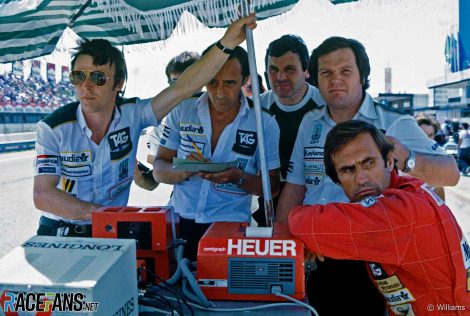
“After that, forget it. It’s just like a fast, red Cadillac, wallowing all over the place”.
An impressive qualifying effort put him seventh on the grid, eight-tenths of a second faster than his team mate. Didier Pironi was beset by turbo problems – Ferrari had followed Renault’s lead in using 1.5-litre turbocharged engines in 1981.
Directly behind Villeneuve was Nelson Piquet, mystified by the unusually poor handling of his Brabham.
The Williams were running true to form near the head of the field but for the third year in a row at Jarama the grid was headed by Jacques Laffite’s Ligier.
Go ad-free for just £1 per month
>> Find out more and sign up
1981 Spanish Grand Prix grid
| Row 1 | 1. Jacques Laffite 1’13.754 Ligier-Matra | |
| 2. Alan Jones 1’14.024 Williams-Cosworth | ||
| Row 2 | 3. Carlos Reutemann 1’14.342 Williams-Cosworth | |
| 4. John Watson 1’14.657 McLaren-Cosworth | ||
| Row 3 | 5. Alain Prost 1’14.669 Renault | |
| 6. Bruno Giacomelli 1’14.897 Alfa-Romeo | ||
| Row 4 | 7. Gilles Villeneuve 1’14.987 Ferrari | |
| 8. Mario Andretti 1’15.159 Alfa-Romeo | ||
| Row 5 | 9. Nelson Piquet 1’15.355 Brabham-Cosworth | |
| 10. Elio de Angelis 1’15.399 Lotus-Cosworth | ||
| Row 6 | 11. Nigel Mansell 1’15.562 Lotus-Cosworth | |
| 12. Riccardo Patrese 1’15.627 Arrows-Cosworth | ||
| Row 7 | 13. Didier Pironi 1’15.715 Ferrari | |
| 14. Andrea de Cesaris 1’15.850 McLaren-Cosworth | ||
| Row 8 | 15. Keke Rosberg 1’15.924 Fittipaldi-Cosworth | |
| 16. Patrick Tambay 1’16.355 Theodore-Cosworth | ||
| Row 9 | 17. Rene Arnoux 1’16.406 Renault | |
| 18. Hector Rebaque 1’16.527 Brabham-Cosworth | ||
| Row 10 | 19. Jean-Pierre Jabouille 1’16.559 Ligier-Matra | |
| 20. Eddie Cheever 1’16.641 Tyrrell-Cosworth | ||
| Row 11 | 21. Chico Serra 1’16.782 Fittipaldi-Cosworth | |
| 22. Derek Daly 1’16.979 March-Cosworth | ||
| Row 12 | 23. Siegfried Stohr 1’17.294 Arrows-Cosworth | |
| 24. Eliseo Salazar 1’17.822 Ensign-Cosworth |
Six drivers failed to qualify and joined de Villota on the sidelines: Michele Alboreto (Tyrrell), Beppe Gabbiai (Osella), Slim Borgudd (ATS), Brian Henton (Toleman), Derek Warwick (Toleman) and Giorgio Francia (Osella).
Jones throws the lead away
Laffite bogged down at the start and was swamped by the chasing pack, slipping from first to 12th while the two Williamses sprinted into the lead. As they completed the first lap cars one and two were first and second, Alan Jones leading Carlos Reutemann.
Several cars had been creeping forward as the red lights turned to green. Villeneuve’s wasn’t one of them – but he made a blistering getaway to clinch third place.
Flogging his Michelins for all they were worth, Villeneuve quickly mounted an attack on Reutemann. Coming from an improbable distance behind at the start of lap two he thrust his way around the outside of the Williams into second place.
Advert | Become a RaceFans supporter and
Reutemann must have sat back and consoled himself with the thought that the Ferrari’s tyres would go off before long. They hadn’t been holding up well and it was a particularly sweltering day in Spain.
This handed Jones a massive opportunity: he was leading, with rival Piquet out of the points in seventh, and his even bigger rival, Reutemann, now bottled up behind Villeneuve. A win, nine points and a reduced deficit to Reutemann in the championship beckoned.
But Jones made an error similar to that of a footballer bearing down on an empty goal who somehow contrives to chip the ball over the crossbar. He inexplicably spun off at the start of the 14th lap at Ascari, handing the lead to Villeneuve.
Laffite battles back
Laffite began his recovery, passing Riccardo Patrese, Bruno Giacomelli and Didier Pironi to move up to seventh. The Piquet collided with Mario Andretti, promoting Laffite to fifth.
Alain Prost was the next to drop out, spinning on lap 29, elevating Laffite to fourth.
Now chasing John Watson, the pair come upon Laffite’s team mate Jean-Pierre Jabouille – and Laffite seized an opportunity to pass, taking third on lap 49. Jabouille, struggling to recover from the leg injuries he suffered in a crash the previous year, retired from F1 after the chequered flag.
Traffic was proving a serious concern on the short, tight circuit. Laffite and Watson reeled in Reutemann, who was having to hold his car in third gear at times as he chased Villeneuve. As they filed past Eliseo Salazar, Laffite squeezed past Reutemann and Watson followed him by.
Advert | Become a RaceFans supporter and
Villeneuve hangs on
Villeneuve carefully reduced the pace, taking all the time he needed in the slow corners where he couldn’t be passed, and using the Ferrari’s prodigious grunt to blast away on the straights. He held up the cars behind him to the extent that they stopped gaining on the next car to be lapped, Giacomelli’s Alfa Romeo.
Villeneuve’s defending was thorough but scrupulously fair: no sudden moves, no chops. He positioned his Ferrari carefully and played his one strong card – its straight-line speed – to perfection on every lap.
The cars behind were tripping over themselves in an effort to pass. Elio de Angelis’s Lotus caught up, making it a five-car train.
Laffite threw everything he had at the Ferrari but Villeneuve resisted him to the end. The five cars crossed the finishing line almost as one, separated by just 1.24 seconds.
“It wasn’t a race, it was a show,” complained Reutemann. “It was very slow, ridiculous, but there was nothing you could do.”
Villeneuve’s defensive tactics meant the average speed for the race was 3mph slower than it had been the year before.
It was a remarkable win – and one that would have been utterly impossible had his rivals had DRS.
Advert | Become a RaceFans supporter and
1981 Spanish Grand Prix result
| Pos | Car | Driver | Team | Laps | Difference / Notes |
| 1 | 27 | Gilles Villeneuve | Ferrari | 80 | |
| 2 | 26 | Jacques Laffite | Ligier | 80 | 0.22 |
| 3 | 7 | John Watson | McLaren | 80 | 0.58 |
| 4 | 2 | Carlos Reutemann | Williams | 80 | 1.01 |
| 5 | 11 | Elio de Angelis | Lotus | 80 | 1.24 |
| 6 | 12 | Nigel Mansell | Lotus | 80 | 28.58 |
| 7 | 1 | Alan Jones | Wiliams | 80 | 56.58 |
| 8 | 22 | Mario Andretti | Alfa Romeo | 80 | 60.8 |
| 9 | 16 | Rene Arnoux | Renault | 80 | 67.08 |
| 10 | 23 | Bruno Giacomelli | Alfa Romeo | 80 | 73.65 |
| 11 | 21 | Chico Serra | Fittipaldi | 79 | 1 Lap |
| 12 | 20 | Keke Rosberg | Fittipaldi | 78 | 2 Laps |
| 13 | 33 | Patrick Tambay | Theodore | 78 | 2 Laps |
| 14 | 14 | Eliseo Salazar | Ensign | 77 | 3 Laps |
| 15 | 28 | Didier Pironi | Ferrari | 76 | 4 Laps |
| 16 | 17 | Derek Daly | March | 75 | 5 Laps |
| 3 | Eddie Cheever | Tyrrell | 61 | Not classified | |
| 25 | Jean-Pierre Jabouille | Ligier | 52 | Brakes | |
| 6 | Hector Rebaque | Brabham | 46 | Gearbox | |
| 5 | Nelson Piquet | Brabham | 43 | Accident | |
| 30 | Siegfried Stohr | Arrows | 43 | Engine | |
| 15 | Alain Prost | Renault | 28 | Accident | |
| 29 | Riccardo Patrese | Arrows | 21 | Brakes | |
| 8 | Andrea de Cesaris | McLaren | 9 | Accident |
Grand Prix flashback
- Schumacher seals record-breaking 10th constructors championship for Ferrari
- Strategic superiority clinches Schumacher’s first Ferrari title
- Disaster for Hakkinen brings title within Schumacher’s grasp
- Schumacher turns the tide against McLaren on tragic day at Monza
- Hakkinen stuns Schumacher with three-wide pass for fourth win
F1 history
- How you rated F1’s 12 sprint races so far – and why two outscored the grand prix
- Alonso set to become F1’s oldest driver for more than 50 years
- From ‘Flying Pig’ to Senna’s heroics: The short, incredible history of Toleman
- From farcical to fantastic: Formula 1’s 14 title-deciding Japanese races ranked
- Benched: The five other drivers who stood down for team mates in last 50 years

damonsmedley (@damonsmedley)
21st June 2011, 9:16
Very interesting read. I’d never heard of this victory before (yes, I’m ashamed) but I’ve only really recently started looking back on Gilles’ career. When I read the headline, I was expecting to discover he pulled away and won by 5 laps or something, but this sounds like a masterful drive. In a way, it sums up Gilles, as he was able to push his car to positions it had no right to be in and this is a fine example. But I’d like to know how many laps he managed to keep them behind. Was it as long as half the race, or just the final few laps?
Either way, I just wish I could have witnessed this era of F1.
Keith Collantine (@keithcollantine)
21st June 2011, 9:19
He led for 67 laps. For the last 19 of those he had Laffite behind him who was pushing him harder than Reutemann was.
damonsmedley (@damonsmedley)
21st June 2011, 9:35
And the turbulence factor would have been minimal (well, at least in comparison to today) so it makes it all the more impressive. :)
xabregas
21st June 2011, 11:47
30 years already!!!!!!!!!
I´m one of those who started to watch F1 back in late 70´s and i can tell you the reason that took me to watch F1 till today was Villeneuve, he was fantastic, allways on the edge, this jarama race was just an example of that but you have a lot more even if his career went short.
Great drivers came to F1 after Villeneuve, the list is long but only one looks like him when racing, Hamilton especially this year.
Worth your time to follow villeune´s career.
unocv12
21st June 2011, 12:08
If this happened today, or in Velencia next time last week in Canada everyone would onthe forums of every F1 related site blasting the regulations for not allowing cars to pass and it being too easy to block and LOOK! Villneuve hardly had to do anything and he stopped anyone from overtaking in clearly faster cars!!! The current F1 regs are horrible. If the cars were more like the ones Senna and Prost drove or even back in the days of Gilles Villenuve then it wouldn’ have happened!!!
But this is old….
kowalsky
21st June 2011, 16:03
i took notice of villeneuve for the first time at the 1982 brazilian gp. He was leading with piquet right behind, and he made a mistake and off he went.
He was fun to watch, but very hard on the car, tyres etc.
My type of driver without a doubt, but closer to montoya, than senna or prost in quality.
aow
26th July 2018, 10:29
The level at which he was ‘Hard on teh car or tyres’ is hugely exaggerated.
His win at Long Beach in ’79 was perfectly modulated.
His win at Watkins Glen the same year with a wounded car, nursing the car home with almost no oil pressure was equally delicate.
In addition he was able to run longer and faster on his tyres than his teammates from ’79 on.
It is common to build up the legend of him as a wild man, and sometimes he did the most extraordinary things, but he was very VERY much more than just that.
Robbie
22nd June 2011, 14:31
Here, here, xabregas!
The Sri Lankan
21st June 2011, 22:07
i wish that they will make a movie on Gilles. He deserves one. i ‘ve heard about one being on the works. but seems like things have stalled
Robbie
22nd June 2011, 14:33
Agreed…not sure what has happened to that project but I hope it is still alive and being worked on.
BasCB (@bascb)
21st June 2011, 9:19
Do I sense an agenda here with highlighing how this would have not been possible with the chasing pack having DRS ;-)
And a great one it is, showing how superb defensive driving is and should stay part of F1!
Keith Collantine (@keithcollantine)
21st June 2011, 9:23
Perish the thought :-)
But seriously, this win was worth an article even without that, the DRS angle is just convenient. But nonetheless interesting. There are other examples of drivers in slower cars winning races they “shouldn’t” have – but it’s hard to see how that could happen today.
Prisoner Monkeys (@prisoner-monkeys)
21st June 2011, 9:24
Sure there is: conspire to have one of your drivers crash on a lap that is ideal for your other driver.
Keith Collantine (@keithcollantine)
21st June 2011, 9:26
I was thinking of more meritorious examples.
GeeMac (@geemac)
21st June 2011, 13:44
Would Vettel’s win at Monaco this season count? Sure the Red Bull is the quickest over a single lap, but in race conditions both Alonso and Button were quicker.
MahavirShah (@mahavirshah)
1st April 2012, 9:30
Alonso this year? Slower car, Sauber taking 1.2 seconds off per lap. Without the error by Perez. Funny how Ferrari at both times :) !
Sasquatsch
21st June 2011, 11:10
Even with DRS it would be hard to overtake Villeneuve. You could block all you wanted those days, compared to today. And since they could drive in each others slipstream because of the ground-effect, there was no need for DRS then.
Hairs (@hairs)
21st June 2011, 13:34
I’m sorry, Keith, but I’m going to have to call “bull” on this slant.
If this sort of defensive driving is impossible in the days of DRS, then I need you to explain why Vettel didn’t get passed in Spain or Monaco.
Change a couple of words:
What’s the difference? If DRS is this “magic button”, then why didn’t Lewis, Alonso, or Button get past him? How long was he out front getting pressured? In the case of Spain, almost start to finish. He didn’t get overtaken. Lewis was in the DRS window for how many laps? The DRS didn’t give the driver behind an unfair advantage that breezed him past with no skill of any kind.
No doubt your intention is to compare Villneuve’s drive with Schumacher’s in Canada. There are several problems with that.
Firstly, as your article clearly states, this was a track, like Monaco, where passing was difficult/impossible. Canada is a track where passing happened even in the days of the Wall of Downforce. So that’s one point that makes the comparison moot. Secondly, as is also clearly stated in the article, Villneuve’s rivals had technical problems, were out of position, or made mistakes to seriously lessen the pressure he could be put under, and to gift him the position he found himself in.
I’m not saying that to take away from Gilles’ win, or his driving – I’m pointing out that your claim that this proves your theories about DRS is entirely wrong. None of the facts match, the situations aren’t comparable, and the claims that people make about what DRS has done are not borne out. Cars and drivers of equal performance are not disadvantaged by DRS. All that happens is that the leading driver doesn’t have an invisible protective wall that stops anyone getting past him. If DRS strips races of driver skill, then so does the Wall.
I’m going to whip out the question I asked in the forum:
Keith Collantine (@keithcollantine)
21st June 2011, 14:14
That all rests on the assumption that Vettel had the same performance deficit to his rivals that Villeneuve had, which was clearly not the case.
That said, if DRS proves as ineffective everywhere else as it was in Spain – i.e., to the point that they might as well turn it off – I won’t be complaining.
Hairs (@hairs)
21st June 2011, 17:59
Vettel was still able to keep faster cars behind with defensive driving, though. And the DRS wasn’t a magic tonic that allowed another driver to override his skill and take the place, as it is often painted.
I still have yet to see DRS allow a slower driver to get past a faster car and stay ahead. Buemi is not going to use DRS to get ahead of Vettel at any point during the year. It’s not an unfair advantage.
And you still haven’t answered my question. :)
Prisoner Monkeys (@prisoner-monkeys)
21st June 2011, 9:23
Defensive driving hasn’t been a part of Formula 1 for a long time. Aerodynamics negate the need for defesive driving skills. How many times have we see one driver who is clearly faster than the car in front get within one second of that car and make no further progress? Even with the DRS, we’ve seen plenty of examples of this.
BasCB (@bascb)
21st June 2011, 10:05
Your not serious here, right?
How was Alonso defending from Schu, and Schu defending from Alonso in 2005 and 2006 and a lot of other races since then not about defending the lead?
The results in China, this year were about defending the lead, just the DRS and KERS use helped Hamilton to get past in the end.
Vettel not being fastest in the end, but defending in Canada and Monaco were about defending, until Vettel cracked and made the slight mistake in Canada.
Prisoner Monkeys (@prisoner-monkeys)
21st June 2011, 10:18
There are exceptions that prove the rule.
hohum
21st June 2011, 15:29
The crucial fact is the Ferrari was “blisteringly fast” in a straight line, that can’t happen now or in the future unless engine development is opened up.
Prisoner Monkeys (@prisoner-monkeys)
21st June 2011, 9:21
And probably impossible anywhere else on the 1981 calendar (except Monaco). Jarama was slow and processional and just as bad as – if not worse than – Catalunya.
damonsmedley (@damonsmedley)
21st June 2011, 9:26
Are you saying the win isn’t impressive?
Prisoner Monkeys (@prisoner-monkeys)
21st June 2011, 9:43
I’m not saying it’s not impressive. I’m saying that the characteristics of Jarama contributed a lot to the result. As the article describes, Villeneuve took his time when he knew he couldn’t be passed, where other drivers might push too hard around the entire circuit. It’s a testament to his ability to read the circuit more than anything else.
BasCB (@bascb)
21st June 2011, 9:59
Just as the characteristics of Monaco contributed to the results there for some 50 years now!
A lot of wins by being able to defend on the narrow streets there as well – defensive racing is a good way to win Monaco, if you start close to the front.
Fixy (@)
21st June 2011, 11:00
That made me chuckle ;)
Cacarella
22nd June 2011, 21:24
I suggest you re-watch the race or re-read the article. Especially the part where Gilles past Reutemann for second place.
You may also want to re-read the entire section which describes how Laffite closed in on Gilles. ‘The characteristics of Jarama’ may be that it is more difficult to pass but clearly not impossible.
montreal95
21st June 2011, 10:02
“except Monaco”
And guess who had won there? ;)
jsw11984 (@jarred-walmsley)
21st June 2011, 11:13
Would it have been impossible though, as the Ferrari had the higher speed on the straight and this being with no engine freeze would his superior straight line speed have still been enough to keep them behind?
hohum
21st June 2011, 15:33
Interesting point, Ferrari has always been about the engine, too bad we no longer have engines to be interested in.
Doance (@doance)
21st June 2011, 9:28
Nowadays F1 sounds like an arcade video game. Detection Zones and Activation Points.
Prisoner Monkeys (@prisoner-monkeys)
21st June 2011, 9:44
Then don’t watch it.
Fixy (@)
21st June 2011, 11:10
But he’s right – like in Mario Kart (which I like – but F1 should keep apart) if you’re behind you can use a mushroom to pass the driver ahead, if you’re in front you can only use bananas to stop the driver passing you. How many times have I won when I was last at the beginning of the last lap? Because the drivers behind have stronger items (mushrooms, special mushrooms, bullet bills) that are designed so that they can win the race.
Herman
21st June 2011, 12:09
Comparing F1 to Mario Kart is exaggerating. I’ve played Mario Kart. In that game, the items are so powerful that the slowest person on the track has a chance of winning. This is impossible in F1. DRS allows the faster car to go past the slower one; if we saw HRTs flying past Red Bulls or something, then you could say one is like the other.
However, I agree with Doance, even if you agree with it being allowed in F1, terms like “KERS boost button” does sound like a video game term.
Andrew White
21st June 2011, 10:31
If this happened today we would be complaining that it’s impossible to overtake. Because it happened 30 years ago, it’s just seen as a great drive.
dennis
21st June 2011, 10:39
Exactly…
Alonso certainly would have passed Villeneuve… And Hamilton probably would have crashed him out.
montreal95
21st June 2011, 10:51
Utter tosh! It was seen as a great drive in 1981, 1981, 2001 and now in 2011 as well. And yes even in 1981 everyone raved about how difficult it is to overtake and that Jarama circuit is crap. But no one denied that it was a great win by Gilles in the Red Cadillac against much better cars overall.
Shrieker (@shrieker)
21st June 2011, 20:31
Alonso should worry about Petrov first.
lol, fail.
Sasquatsch
21st June 2011, 11:20
In those days there were more overtaking actions than the past 20 years (with the exception of this year, because of the tyres and DRS) so yes, it was a great drive.
With today’s anti-blocking rules (only one move allowed on a straight) it would be a lot harder to stay in front than in 1981. I think it compares to Senna holding of Mansell in Monaco 1992, which also would be almost impossible today.
Come to think of it, even with the anti-blocking rules the overtakes in the past years are less than when blocking was allowed, so there is something fundamentally wrong with F1 (cars), which DRS can’t cure, but ground-effect can.
Keith Collantine (@keithcollantine)
21st June 2011, 11:40
I don’t agree at all. Villeneuve’s driving wouldn’t come close to the limit of what’s allowed in terms of defensive driving today.
Lindsay
21st June 2011, 18:37
Truer words have never been spoken. Drivers simply didn’t block each other back in the day, that behavior started with Senna.
In fact, there is an article by Nigel Roebuck in last month’s issue of Motorsport about this exact subject.
Sasquatsch
27th June 2011, 11:53
Keith,
You’re right. After watching the video again I agree that there is hardly any blocking done by Villeneuve.
Probably just my memory that played tricks on me.
I still think that DRS wouldn’t have helped Laffite to overtake Villeneuve, just because the straights were too short (or so it seems). Besides DRS with ground-effect would be even more unfair than today, because DRS is introduced because cars cannot ride in each others slipstream. With ground-effect in those days they could.
bosyber
21st June 2011, 10:32
Very nice article. While reading I was also pondering DRS and this result, I wonder if anyone going for DRS was.
The racing in Barcelona this year was a bit like that though, even with DRS (well, opposite, with Vettel being fast in the corners, I suppose). Vettel was a bit slower, probably, over a lap, but he made sure to use his advantage in the place where it counted.
Even with DRS, we do see great defensive driving, it just means that it takes longer before the DRS works, and is complicated by having to make sure the DRS isn’t effective, so it is harder to make it happen, and more depending (possibly) on your car and set up.
montreal95
21st June 2011, 10:42
Keith I understand you’re against DRS and your reasons for it. Don’t agree but understand. However this is a very unfair comparison you’ve made here. To claim that the reason such a win would’ve been impossible today cause of DRS is to ignore some very important factors:
1) The cars could’ve followed each other much more closely then without the aerodynamic interference of nowadays cars. Even at Jarama there were many overtakes during that race and it’s a testament to Gilles skill that he managed to hold off Laffite when so many others have fallen to him. So Laffite didn’t have DRS but he also didn’t have the terrible turbulence to fight with.
2) The circuit-Jarama is in many ways like Monaco. As PM rightly said above such a win would’ve been impossible on any other track in the 1981 season bar Monaco. This is possibly an even more important factor than car performance.
And look what happened in Monaco this year. Yes I know everyone says? Button or Alonso or both would’ve probably overtaken Vettel if not for the red flag. But I’m pretty sure that everyone who saw Jarama 1981 live said to himself that Laffite would overtake Gilles sooner or later. Vettel COULD’VE held them off, even with the DRS, and his tires in bad condition. Because it’s Monaco.
3)To say that such a win would’ve been impossible because of the DRS is to overlook another important factor-that the differences between performance of various components on the cars,most notably the engines, were much greater then. The Ferrari turbo monster in 1981 was way more powerful than the Cosworth in 1981, and that was key factor in the win. But today, with frozen engines, the difference between the best and the worst engines in F1 power-wise is around 20-25 bhp no more, barely above the bhp gain from DRS.
To conclude, I’m not sure if such a win is impossible to replicate today, but if it is, DRS is just one of many factors for it. I just wish we had another Gilles to help us check it out. But as it was said millions of times before, there will never be another Gilles. RIP
Keith Collantine (@keithcollantine)
21st June 2011, 10:49
I’m not getting bogged down in the mechanics of literally whether it would have made the difference – we could argue that toss until the sun goes down and then back up again.
But you can’t deny that DRS has undermined – perhaps entirely – the skill of defensive driving, which is what made this such a celebrated victory.
Incidentally, I’m not entirely opposed to DRS – this is pretty much my view on it at the moment: DRS: Separating the good from the bad
montreal95
21st June 2011, 11:09
Not entirely undermined. As bosyber rightly pointed out the defensive skill still plays a role. But the whole point of introducing DRS was to give the defensive driving the role it played in the 80’s as opposed to the role it played through much of the nineties and the noughties. In the eighties, even if your defensive driving was perfect, it took a very special set of circumtances to stay ahead of faster cars for the whole race.
But lately all the driver in front needed to do was not to make a mistake and he knew that the only place where he could be overtaken is in the pits. In fact that could’ve maid them a little complacent regarding their defensive skill. I mean what’s the point of honing your defensive skills if your car’s wake does all the job for you? No there’s a thought!
Keith Collantine (@keithcollantine)
21st June 2011, 11:42
I think Canada showed the modern value of defensive driving when Button flew past Schumacher about a quarter of the way along the DRS zone.
I.e., nil.
montreal95
21st June 2011, 12:42
How can you compare Canada and Jarama? That overtake you speak of is the combination of a circuit layout, much faster car and slipstreaming on a very long straight plus DRS. What was the effect of defensive driving during slipstreaming on the Monza straights? and I’m NOT talking about pre-chicane Monza but the 1980’s? Yes, precisely nil. And to think that 20 years ago Canada was considered one of the most difficult tracks to overtake on(altough admittedly the circuit layout is a bit different now)…
Hairs (@hairs)
21st June 2011, 22:15
Button was over two seconds a lap faster!
The DRS didn’t make him that fast, and do you know how you can tell? He was two seconds a lap faster when he got past him, that’s how!
Honestly, Keith, for a man who has had so many articles debunking popular mythmaking and looking at facts, I’m surprised at you.
It took Mark Webber 15 laps to get past Schumacher. Look at your own chart. https://www.racefans.net/2011/06/13/2011-canadian-grand-prix-analysis/
Please explain how the DRS failed to work, and how there was no ability for Schumacher to defend, for 15 laps. It worked, as you clearly state, for Button. Why didn’t it work for Webber? Bear in mind, two laps after he passed Schumacher, Webber was almost 2 seconds ahead of him.
Your argument does not stand up to any rational analysis.
Icthyes (@icthyes)
21st June 2011, 22:48
To be fair Hairs, some of that 2s per lap was because he had a DRS boost from Webber and Schumacher.
Also, DRS was only open for a few of those 15 laps you quote. I think Webber got him on the second or third try.
I don’t agree that DRS would make a repeat of this impossible because we saw what happened in Barcelona and Jarama was a similar overtaking-killer. But what we saw in Canada was ridiculous really.
Hairs (@hairs)
22nd June 2011, 0:10
Sorry, Icthyes, DRS had nothing to do with Button’s speed. The lap charts can tell you that.
In clear air, as soon as he was past Schumacher, and before he was in the zone with Vettel, he steamed away.
Magnificent Geoffrey (@magnificent-geoffrey)
21st June 2011, 15:14
But saying that, Keith, the vast majority of DRS overtaking ‘attempts’ I’ve seen FOM broadcast live this year have not resulted in a successful overtake.
Again, why the hyperbole? DRS has not undermined the skill of defensive driving. The whole idea of DRS is to directly counter the ‘dirty air’ problem. If anything, the ‘dirty air’ effect does a lot more to undermine the skill of defensive driving as it makes it much easier to keep a car behind you. You don’t need to do any defensive driving at all if the car behind can’t get into an overtaking position to begin with, do you?
Also, while I agree that the DRS debate is a good one to have this year, I don’t quite understand why it’s necessary to even bring it up at all in an article about something that happened 30 years ago! Unless you’re deliberately trying to troll people like me, which if you are I’ll admit that you’re doing a good job! :P
Keith Collantine (@keithcollantine)
21st June 2011, 15:28
It’s not, you just don’t agree with me.
We’ve got drivers pressing buttons to get a speed boost which sends them zooming past defenceless rivals in the middle of straights. How has that not undermined it?
Because then more people will read it.
Magnificent Geoffrey (@magnificent-geoffrey)
21st June 2011, 16:28
You’re right, it wasn’t really the right word for what I was trying to say.
This is my issue with this argument. You are not ‘defenceless’, in my opinion. If Massa was ‘defenceless’ during the opening laps of Melbourne, Button should’ve breezed passed Massa on his first try with DRS on Lap 3, but he didn’t. Like I said, the majority of DRS pass attempts I’ve watched this year have not resulted in a pass. You are able to make your move to defend and position your car in a way that makes it difficult for your opponent to pass you, you cannot simply drive around the opposing driver without any form of resistance at all, so I really don’t like it when people use the word ‘defenceless’ as in my opinion and experience that’s simply not true.
In terms of undermining defensive driving, I can see the argument that it makes defending a position more difficult but I still maintain that the DRS serves to equal what were actually skewed odds to begin with. We want to see close racing, for sure, but I didn’t like seeing drivers having difficulties attempting to overtake because they couldn’t get close enough to begin with, as we saw so many times over the last few seasons. Just by the nature of being in front of someone, I would be able to keep them behind me not because of my own skill but from the sheer turbulence from my car on the air alone. That’s not defensive driving in the slightest. If drivers are going to keep other cars behind them, I’d much rather see them do it through the active defending we saw from Massa in Melbourne over the passive defending from so many ‘dirty air’ races over the years, like the two Imola races in ’05 and ’06. Also, while DRS is only applicable on one (well, two now, but should be one) corner per lap, we’ve seen countless overtaking moves this season in non-DRS corners. Drivers still have to be prepared to defend at every corner on the circuit, and not just DRS-zone corners, which means the nature of defensive driving is, the majority of the time, no different to how it has been in recent times. While DRS equalises the playing field in favour of the attacker for one/two corner(s) a lap, most of the time the defending driver enjoys the natural advantage of being in cleaner air. So you could say DRS (in combination with all the other elements this year) has helped to make defensive driving a more important aspect of racing in 2011 than at any other time in recent history.
Ultimately, it does depend a lot about the areas in which you’re allowed to use it. Istanbul was an example of where there was too much of an advantage to the attacking driver while tracks like Malaysia and Melbourne were examples of where it worked much more effectively. This is going to be a long-term solution that will require a lot of fine-tuning, but I think DRS has been a positive addition to the Formula and I hope we give it enough time to be perfected before doing away with it too hastily.
Damon (@damon)
21st June 2011, 16:51
Magnificent Geoffrey, the bottom line is that there were instances when a car was defenceless against a DRS using car (e.g. Schumacher vs. Button).
Hairs (@hairs)
21st June 2011, 22:18
Schumacher was defenceless because Button was faster. Much faster. Much, much, much faster. Very much faster. All over the track. He was faster. How often does it have to be pointed out?
Would you rather Button wailed up to the back of Schumacher, and then hit an invisible wall, and was stuck there for the rest of the race, unable to slipstream, unable to get close enough to outbrake, unable to get past? Is that better?
Prisoner Monkeys (@prisoner-monkeys)
21st June 2011, 11:13
It’s been a long-held argument of mine that circuit design depends a lot on the land set aside for circuit – moreso than the actual designer. Hermann Tilke has great circuits like Istanbul, Sepang and Austin, but at the same time, he had bland ones like Abu Dhabi and Shanghai.
I think Jarama proves this more than anything. The circuit was designed by John Hugenholz, the man who developed Suzuka and Zandvoort, and who was basically the Hermann Tilke of the 1960s and 1970s. But for all the brilliance of Suzuka, Jarama stands out as one of the circuits that was not exactly conductive to good racing.
attila0427
21st June 2011, 11:27
Hi guys!
Who is on the left side in sunglasses?
https://www.racefans.net/wp-content/uploads/2011/06/will_jone_head_reut_will_jara_1981-208×117.jpg
Gnarly Racing (@)
21st June 2011, 22:14
Didn’t realise Sam Michael had been with the team that long!
HounslowBusGarage
21st June 2011, 11:37
I remember the race well. As a youngster I was medically dependent on F1 and I remember watching this on TV with Murray Walker squeaking commentary at me.
For me, it was the most frustrating race I had ever seem with this ludicrous ‘mobile chicane’ on a narrow and dusty mickey mouse circuit – factors which conspired to rob me (and probably millions of other) of a “good race”.
I agree with PM, Jarama was a horrid track. But the performance characteristics of the Ferrari turned a bore into a bad dream.
Don’t get me wrong, Villeneuve was entirely right to do what he did and showed his real ability to drive with his head as well as heart. But at the time, I thought it was awful.
JimN (@jimn)
21st June 2011, 12:17
I have totally the opposite memories, for me this was probably the greatest race I ever watched (on TV). After Villeneuve got in front I was on the edge of my seat for the rest of the race. At each corner it seemed that he was about to be overtaken, and somehow at each corner he managed to stay in front, to me it was mesmerising. But it must be remembered that then, braking distances were long with overtaking was reasonably common then, as was mechanical breakdown when under pressure. The suspense was because we thought he would and could be overtaken… not as in the recent past because overtaking was practically impossible.
montreal95
21st June 2011, 12:33
+1 great post!
My thoughts exactly. Lucky you, to have witnessed it live. I wasn’t even born then. But even when I watched the full race recording for the first time a couple of years ago and knowing the result I had the nagging feeling that in the next corner it’ll definetely be over and Gilles will be overtaken! I was almost surprised when he wasn’t ;)
LuvinF1
21st June 2011, 14:01
For me, you are on the mark HBG. It all depends on your point of view. In 1981, I rooted for Lotus first, Williams second, and McLaren third. So to me, a moving chicane was frustrating.
xabregas
21st June 2011, 12:16
Sure it was one of those tracks where it was really difficult to overtake, i could say the only place you could do that was at the end of the main straight but you´re forgeting that the Ferrari was good ONLY at the straight, how about the rest of the track, it was the driver that made the difference and what you´ve seen in this video was only the last lap but the 66 laps before were almost like the last one, and it wasn´t allways the same driver pushing Villeneuve and he didn´t do any evasive manouvers to avoid beig overtaken like we´re used to watch in today´s F1 races.
Steph (@)
21st June 2011, 13:25
I wasn’t alive during Villeneuve’s career but he’s such an intruiging legend to me far more so than Senna.
I imagine that quite a few people such as HBG found this race rather processional and dull and as I didn’t watch it live my comment should be taken as a display of rose tinted glasses syndrome but reading and watching the race back I find it rather exhilerating. I’ve never needed passes to be excited by F1 as I find anticipation a lot of the fun so this is really thrilling for me. As much as the circuit didn’t suit Ferrari’s outright pace it did aid their cause by being a nightmare to overtake on but Gilles still did everything right and it was a performance I half expect of someone else as Gilles is never portrayed as the smartest of drivers but more wild.
Thanks for this article Keith ity’s made my day. I think it was a magnificent win by one of my favourite ever F1 characters.
damonsmedley (@damonsmedley)
21st June 2011, 15:18
I can’t say I’ve been completely won over by Gilles, but I understand how unfair it is that we weren’t born into this era! :P It’s nice seeing how much of a fan you are and how much he means to you, too. :)
wasiF1 (@wasif1)
21st June 2011, 13:42
Reading the article make you feel that it was a great race back then.If I could haven got access to all the video’s of F1 I should have had love to have the race video of all the races from 1950 with Murray Walker & Martin Blundel as the commentator.
damonsmedley (@damonsmedley)
21st June 2011, 15:15
But Martin was only born in 1959! :P
HounslowBusGarage
21st June 2011, 21:19
Erm. It’s either Martin Brundle or Mark Blundel. As far as I know, no one called Martin Blundel was ever associated with F1 (and I think you mean Martin Brundle).
Before Martin, Murray had Jonathan Palmer for a side kick, before him it was James Hunt. Not sure if there was anyone before that, but in 1981 I’m pretty sure Murray Walker did the commentary solo.
wasiF1
22nd June 2011, 2:44
I meant Martin Brundle,apology for my spelling mistake. What I wanted to say is that they will be commentating now for those old races as early days there were no commentary.
A4P
21st June 2011, 14:10
“And it was a win that would simply be impossible to repeat today.”
Check out Singapore 2010. Oh, I forgot. You Brits are too proud to admit that Alonso is the legend of these days.
Keith Collantine (@keithcollantine)
21st June 2011, 14:27
They didn’t have DRS last year. If you’d made it to the end of the article you might have realised that was the point.
And spare us the jingoistic rubbish, thank you.
Pingguest
21st June 2011, 14:16
Not only DRS makes a repeat of the 1981 Spanish impossible, pit stops make it impossible too.
Bernard (@bernard)
21st June 2011, 14:17
This is an outcome I’m not so certain of. The cars 3 decades ago had much less downforce (and therefore a much smaller wake) than today plus as pointed out in the article there was significant straight line performance differences between cars thanks to the turbo engine. In all likelihood this would have rendered any rival DRS ineffective against him.
Besides, to gain as much from DRS then as we do now, the cars of the early 80s would probably have to remove both front and rear wings almost entirely as their drag relative to today is much less to begin with.
DRS is not a guaranteed pass, it is a levelling device to counter the enormous wake of the car ahead.
There are also other variables to keep in mind during every pass: engines and mapping (not forgetting EBDs), gear ratios, fuel, balance, mechanical and aero setup, KERS, driver input and – most notably this year – the tyres.
If all the above are equal between the cars in question then DRS will aid overtaking – as intended. If the above are not equal, overtaking will be increasing easier or increasing more difficult – DRS or no DRS.
Sasquatsch
27th June 2011, 11:59
Cars in these days had more downforce because of the ground-effect, regardless of the wake. Some cars even didn’t have wings, because the whole car was behaving like a wing.
Don M.
21st June 2011, 14:48
It is possible that DRS would have no affect if there was a race like Spain ’81 this season. If there had been cars queued behind Hamilton at Barcelona they would all be using DRS and unable to pass each other. DRS is ineffective in a train of cars if the first car that can deploy it is unable to complete an overtake.
There was a situation in Turkey where Button was badly held-up by Massa because the Ferrari was able to use DRS but couldn’t pass the car (Rosberg?) in front. They sorted it out eventually but, in that case, overtaking took place despite DRS rather than with the aid of it.
So DRS can be ineffective as well as being unsubtle and unfair. It also robs us of some genuine racing – Button was perfectly positioned to attack Schumacher into the hairpin in Montreal, but clearly waited for the easy pass with DRS on the following straight. That’s bad for racing and so is making sitting ducks out of drivers, like Kobayashi, who have gained good track position in inferior cars.
Hopefully DRS can be consigned to history very soon. The FIA should remove the need for it by tackling the overtaking problem properly. The Pirelli tyres have already improved the situation. A few aerodynamic tweeks would complete the job.
Ads21 (@ads21)
21st June 2011, 15:36
Regardless of the DRS argument (I happen to agree with Keith) we should never need an excuse to celebrate how brilliant Gilles Villeneuve was. This race was an absolutely remarkable demonstration of defensive driving and is a reminder that Villeneuve wasn’t only about power-slides and driving around on 3 wheels, he was the best driver of his generation.
Kershan
21st June 2011, 15:37
It’s because of articles like this that we love you, Keith …
hohum
21st June 2011, 15:44
Keith, do we have the statistics on the 1981 Ferrari ie. Max rpm, horse power, fuel capacity. I think it would be interesting to compare the engine of 1981 with the proposed engine of 2013 so we can see the technical advances in 32 years of F1.
Tim
21st June 2011, 16:27
Wikipedia says (and this sounds about right) 600bhp in qualifying trim, 550bhp for races. By contrast, the best Cosworth DFV would have produced around 520bhp at the time.
RPM would have been much lower than modern racing engines.
hohum
21st June 2011, 16:53
Thanks Tim, as you may have noticed this is a hobbyhorse of mine. So in 2013 we expect to have a similar engine 100cc more capacity (1.6 l) and 50 more horses in race trim. What fantastic progress in only 32 years!
Ferrari can start the 2013 season with this engine just by using modern materials, compressed air valve springs and direct injection, no need to design and build whole new engine.
JimN (@jimn)
21st June 2011, 19:33
All engines at the time maxed out at about 12,000 rpm. The limitation was valve springs, and one firm made them for all F1 engines. There was a small variation between the makes of engines because of differing valve size but not much. From memory the Matra engine reved the most but only a few hundred rpm more than the DFV or Ferrari.
hohum
21st June 2011, 21:24
Thanks JimN I figured valve springs to be one of the limiters to rpm and reliability and since the new rule includes a 12,000 rpm limit modern compressed air valve actuation that works over 20,000 rpm should provide great reliability at 12k. I say again, a new head casting to allow compressed air valve springing and direct fuel injection a small overbore to take cylinders from 375 to 400 cc. one of the latest off the shelf turbochargers and voila a max power 2013 spec. F1 engine. Sort of like the V8s in Nascar.
hohum
21st June 2011, 22:56
Decided to do some research myself and came up with 2 important facts. 1. this was a V6 so unless Whitmarsh gets his way it wont be in spec. for 2013. and 2; by 1983 was developing 700hp. Will try to find specs. for Renault Turbo.
hohum
21st June 2011, 23:17
Renault was V6 also, allright that means we have to use the BMW M12 4 cylinder engine to power our 2013 F1 car but the good news is it was putting out 1,000 hp. in race trim in 1986 and max revs were only 11,200 so all it needs is a little de-tuning for 2013.
pH
21st June 2011, 16:01
Check out the grid. Five different cars in the first six places. When was the last time we had a variety like this?
And I had four of these five cars built from paper as a kid :-).
hohum
21st June 2011, 16:55
probably the last time we had engines with different power characteristics.
Tom
21st June 2011, 18:22
Five different cars in the first six places?
Canada 2011
pH
21st June 2011, 23:23
Probably a misunderstanding, when I wrote “grid”, I meant the starting grid, not the GP standings. There were only four teams starting in top 6 in Canada.
Curiously, there were always four teams in top 6 on the grid this year. Theoretically there can be between three and six. The six seems very unlikely to me, and five quite rare, since two of the holy triumvirate RB-McL-F would have to screw up. However, I would expect that in seven tries they would get it perfect at east once and we would have all top positions occupied by these three teams.
If Vettel clinches the title before summer break, we may start worrying about making it four throughout the whole season to put some suspense into the rest of it :-).
Tim
22nd June 2011, 8:38
It happens more often than you think. There were five different cars in the top six places on the grid in Malaysia and Monaco last year.
In Japan, drivers from six different teams qualified in the top seven – Red Bull, Renault, Ferrari, McLaren, Mercedes and Williams.
Tom
21st June 2011, 18:07
Why should a victory of 30 years ago be possible today? F1 is not about the past. Nostalgia is a disease.
hohum
21st June 2011, 18:24
Whats that quote about history and being doomed to repeat it. Good luck Tom, you are going to need it.
Tom
21st June 2011, 18:33
But it seems like Keith just wants to repeat the 1981 season over and over.
hohum
21st June 2011, 18:59
Don’t worry, they had fewer races then.Soon we will be onto 82
alelanza (@alelanza)
21st June 2011, 21:24
Thanks for the article, loved the red caddy referrence. However the Villeneuve legend has always escaped me, as much as i think he was a very good driver and one who would do wacky things such as driving around in Canada in miserable rain with his front wing blocking most of his vision, or trying to get back to the pits with a destroyed rear suspension, i don’t think he would be held in such high esteem had he not died. And i think this article is proof of this.
During the dfv to turbo overlap years, it was very common to see the Ferrari or Renault trains, these cars were usually heavier, also needed more fuel and usually didn’t have a chassis as good as the williamses, brabhams or even the ligiers. Yet they were significantly more powerful so the trains (usually boring IMO) were very common and more often than not robbed us from watching duels between the better cars just because of the buffer created by the slow going crude turbos.
So what set this one apart from all the other boring trains? the turbo in front didn’t break down as they usualy did!
And particularly important to the Jarama race, the NA engines would lose a significant amount of performance (600+ m over sea level) whereas the turbos could be tuned to compensate for the pressure deficit.
Did i think it was a great race? absolutely, i liked it very much, as someone here said i think F1 is all about the anticipation, not so much about having passing maneuvers left and right. Do i think Gilles’ skills had to do with it? of course, he was driving the thing and he did quite well to hold it together. But looking at the race in the telly (and i rewatched the whole thing earlier this year) i don’t think it was that impressive a drive. I think the Villeneuve train came ages before the Trulli one did (just resurrect and then ask James Hunt!), Jarama was just one of many, except this time the engine didn’t give up the ghost :)
hohum
21st June 2011, 21:32
Yes but don’t forget the times the NA cars passed the turbos exiting the corner because they had better low end torque and a more linear power curve, or the times the turbos spun out because of their on-off power delivery. Variety is the spice of life. Viva la difference.
alelanza (@alelanza)
21st June 2011, 22:09
Hmmm… i don’t remember too many of those, actually i don’t. During race starts yeah, the Renaults especially suffered badly, not so much the Ferraris. Actually i remember what you describe in Long Beach, but i also remember the Ferrari repassing on the same straight once the turbo had kicked in. Which made for a very fun race :) so yeah i agree, variety is good :)
Steve
22nd June 2011, 1:48
you know what the problem with the pro-drs argument is?
they believe that a faster car has a ‘right’ to be ahead of the slower one.
‘button was 2 seconds faster than schumacher at montreal’, so what, schumacher had driven a better race, not made any mistakes & had driven himself into 2nd position. if button hadn’t driven into hamilton & alonso & had to make 6 stops he never would have ended up behind schumacher to start with.
like someone said last week, just because a car is faster doesnt mean it has the right to be ahead.
something i would point out is that it looks as if drs is becomming less popular as the season goes on, you only have to read the comments on james allens blog and many other f1 fan forums to see this.
i started off without an opinion on drs as i wanted to see it in action before making a judgement on its effect. after 7 races im fairmly against it to the point where its starting to harm my enjoyment of races.
im hoping fan opinion continues to turn against drs so we can drop it for 2012 & get back to proper racing!
Robbie
22nd June 2011, 14:20
I’m not a fan of the gadget that is DRS and would prefer they go back to smaller wings and bigger tires such as they had in the 70’s and 80’s.
That said, while as you claim a faster car doesn’t necessarily have the ‘right’ to be ahead of a slower one, it is also ridiculous for a faster car to be held up by dirty air of a slower car to the point where it can never get by due to that physics and nothing to do with driver skill or nerve or lack thereof.
MS had a good day but he hasn’t been brilliant since his return to F1, and nor was he brilliant in Montreal…he benefitted from the luck of timing of tires and of cars falling out of his way in front of him as much as driver skill, and a race such a this with mega safety cars and stoppages and changeable conditions became as much a crap shoot as anything. ie. not one to be claiming MS is back…Same for JB really…like you point out, there’s a lot of ifs, ands, or buts about this race with JB too.
MS only eventually got to 2nd position by at one point using DRS himself to get by NH. Fair enough, that was the circumstances of the day. He used it to his advantage just as MW and JB did. I think what has highlighted this particular day was the huge variables, the final 10 laps of finally having dry racing albeit on one racing line only, and the fact that many people’s hero MS (not mine though) might have podiumed after a dismal return to F1.
Reality is MS and the Merc aren’t good enough to belong on the podium and to have done so would have been due to circumstances, not because suddenly the Merc belongs there or that MS has found his way. It made more sense to me to see two Red Bulls and a Mac on the podium even though I would rather no DRS, which would have seen circumstances differently and MS not likely looking at a potential podium.
As I said I am no MS fan and it would be interesting to me if his fans would be happy with the only way for him to podium being due to the extreme circumstances of Montreal. I’m sure had it happened some headlines would read ‘MS is back’ but I’d be the one saying ‘you sure about that?’
Bottom line for me, I’d prefer no DRS, and I acknowledge that at some tracks it has been less effective than at others, and one must be careful not to look in hindsight and see how it ‘ruined’ a race near the end, when it was one of the very things responsible for the order of the cars once the race came to it’s closing stages.
AndrewTanner (@andrewtanner)
22nd June 2011, 7:45
A great read :) We wouldn’t have had JB’s victory in Canada had it not have been for DRS.
Swings and roundabouts ;)
Steve
22nd June 2011, 10:11
but we would have had a brilliant scrap for 2nd between schumacher, webber and button for the final laps (with perhaps a real & exciting pass happening) which would have been 10x more exciting to watch than the easy drs push of a button passes we got.
also let us not forget that kobayashi was basically robbed of 6th place because massa was able to use drs down the finish straght. he was as defenceless as schumacher was to defend against massa once massa hit his drs button.
Robbie
22nd June 2011, 16:42
Having never been an MS fan and for years having to watch the deck stacked in his favour at Ferrari and against the rest of the grid, I thoroughly enjoyed seeing MS defenceless for a change. Not that I am a fan of DRS, but I am an even lesser fan of MS, so to me the scrap for 2nd WAS brilliant…MS getting a taste of his own medicine if you’d like after years of us being robbed of true racing in the pinnacle of racing when the dominant MS/Ferrari’s did not race each other, by contract.
Again, MS was only in 2nd not because the Merc belongs there, and not because MS has shown himself to belong there since his return, but because of a topsy turvy race and because he himself used DRS earlier in the race. Live by the sword, die by the sword.
As I say, I would prefer no DRS too, and if that were the case MS would not have been in 2nd with 10 laps to go in Montreal.
StefMeister
22nd June 2011, 10:23
One of the things I hate about DRS is how it often takes away the excitement and unpredictability of the racing.
In Montreal for instance with the Schumi/Webber/Button fight for 2nd, As soon as Webber got into the DRS zone the 1st time & you saw just how big a speed gain DRS gave him, It was obvious Schumi wasn’t going to finish 2nd.
It took away a lot of the excitement & unpredictability of that fight as it made the outcome predictable.
I actually found the fights for the win at the Spanish/Monaco GP’s more exciting because DRS was ineffective on those circuits so we had a real fight for the win (And other places through the races) with no idea what the outcome would be.
Robbie
22nd June 2011, 14:29
Not a fan of gadgets either, but faster cars stuck behind slower ones for lap ad infinitum takes away from the excitement and unpredictability too. How many races have we had where the outcome was predictable due to a faster car stuck behind a slower one due to physics?
I understand why they introduced DRS…because they wanted to get away from the parade effect, and from the majority of passing being done through pit strategies ala the MS/Ferrari era.
I would just prefer they get away from the parade effect without gadgets…give em back their big fat slicks and limit their wings I say…then we’ll see passing of the mechanical grip type and by the seat of the drivers’ pants, not by DRS.
ferrox glideh (@ferrox-glideh)
2nd February 2017, 2:53
It’s 2017, and this article is still fresh!