



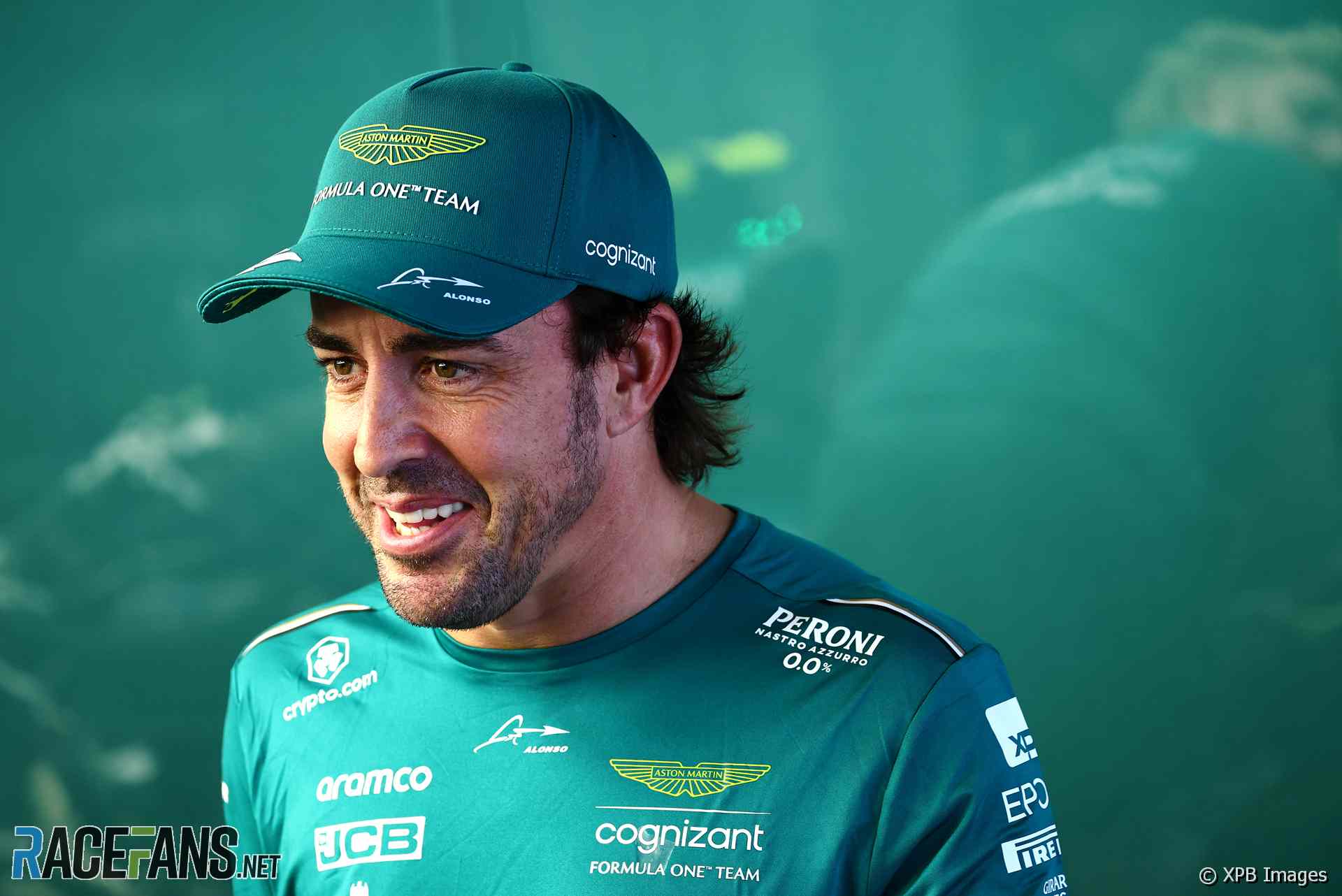
Fernando Alonso made his start in motor racing at the wheel of a kart his father originally bought for Fernando’s sister.
Fernando Alonso biography
Birthplace: Oviedo, Spain
Find all RaceFans who support Fernando Alonso
Teams
Minardi: 2001
Renault: 2003-06
McLaren: 2007
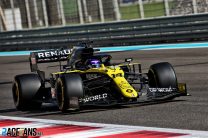
Renault: 2008-09
Ferrari: 2010-14
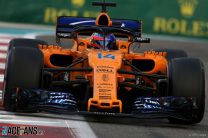
McLaren: 2015-18
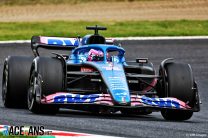
Alpine: 2021-22
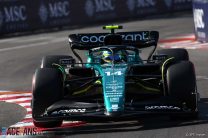
Aston Martin: 2023-
Career stats
Alonso arrived in Formula 1 with Minardi in 2001 and four years later won his first world championship. He made it back-to-back titles the following year before making an ill-fated switched from Renault to McLaren.
He returned to Renault following an acrimonious split from McLaren, and in 2010 took Kimi Raikkonen’s place at Ferrari.
Karting
Alonso won all eight races in the first series he entered in 1988. As he also continued to perform well at his Santo Angel de la Guarda school his parents were happy for him to continue karting.
In 1993 he won the Spanish karting championship with the Genikart team. Two years later he finished third in the World Championships and won the Junior World Championship in 1996.
That year he was spotted by former Formula 1 driver Adrian Campos at the Marlboro Masters race in Barcelona, with Alonso won. It was Campos that gave Alonso his first test in a racing car, with Campos’ Formula Nissan team, at Albacete in October 1998.
Formula Nissan and F3000
Although he crashed twice during the test, by the third day he had matched Campos’ race driver Marc Gene’s pole position time from the race at the track earlier that year.
Alonso was confirmed with Campos racing for the 1999 Euro Open Movi Star by Nissan series (which later became the World Series by Renault).
He took his first win in the series in the second round at Albacete. Entering the final round of the season he had 125 points to championship leader Manuel Giao’s 144. Alonso needed to win and take the fastest lap (which was worth an extra point) in the final round at Valencia to claim the title.
Alonso got the job done, which led to his first F1 test at the end of the year with Minardi. He impressed sporting director Cesare Fiorio, beating the other young test drivers by 1.5 seconds.
Fiorio said: “The first thing I did was to call [Minardi boss] Gabriele Rumi to draw up a ten-year contract for him before word got round F1 about Fernando and someone stole him from us.”
For 2000 he progressed up the motor sport ladder to Formula 3000 with Team Astromega, following an impressive test for Coloni at Jerez. He had arrived in the closest series to Formula One in only his second year of racing cars. He was the youngest driver to contest F3000 that year by 11 months.
But it would be a difficult season. Alonso improved his English to communicate better with his mechanics and only at the end of the season did the results start to come.
He scored his first point in the seventh round of ten (at the A1-Ring) but took second in the penultimate race the Hungaroring and won the season finale at Spa-Francorchamps. Despite having only three points finishes, he nevertheless finished fourth in the championship behind Bruno Junquiera, Nicolas Minassian and Mark Webber.
Minardi
2001
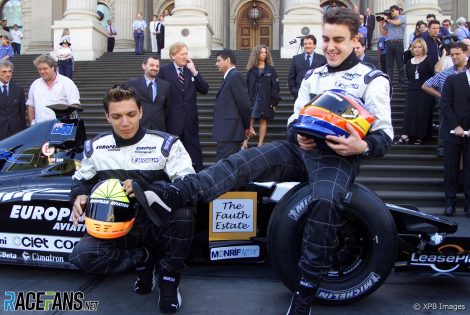
A race against time to prepare Minardi for the 2001 season was won, and Alonso made his grand prix debut alongside Tarso Marques.
Marques had 12 Grand Prix appearances under his belt, but Alonso put him in the shade from the first qualifying session of the year. Alonso took 19th on the grid, displacing Gaston Mazzacane and Luciano Burti’s faster machinery, and beating Marques by 2.6 seconds.
That set the pattern for the year. But the PS01 rarely had the speed to let Alonso display his talent over a race distance. The team suffered poor reliability after the re-introduction of traction control early in the season.
Nonetheless Alonso demonstrated his speed in qualifying: 18th in Imola ahead of both Benettons, which he repeated at the A1-Ring. Marques’ started the same races from 22nd and last.
There were hiccups – notably while driving a two-seater Minardi at a fans’ day at Donington Park. With ITV-F1 presenter Louise Goodman on board, Alonso’s car was struck by that of 1992 World Champion Nigel Mansell (with businessman Jonathan Frost). The collision pitched Mansell’s Minardi into the air.
The final round of 2001 was at Suzuka – a track which Alonso had never raced at before, which wasrenowned as one of the most difficult on the calendar. He responded beautifully to the challenge: qualifying 18th and finishing 11th, beating Heinz-Harald Frentzen’s Ferrari-powered Prost, Olivier Panis’ BAR-Honda, both Arrows and his new team mate Alex Yoong.
Advert | Become a RaceFans supporter and
Renault
2002
For the following year Briatore was eager to slot Alonso in at Benetton, which was being taken over by Renault, in place of British driver Jenson Button. Button had fared poorly compared to team mate Giancarlo Fisichella in 2001.
But Button kept his seat, Fisichella traded places with Jarno Trulli, and so Briatore moved Alonso into a test role.
Twelve months and 1,642 laps of Silverstone, Valencia, Jerez and Catalunya later, Alonso was promoted to the Renault race team for 2003, replacing Button.
2003
He did not disappoint. At the second race of the season in Malaysia he became the youngest ever pole position holder.
Then, in Hungary, he claimed the title of youngest ever Grand Prix winner, lapping eventual champion Michael Schumacher en route.
He completed his first season in a competitive car sixth with 55 points, 22 more than team mate Trulli.
2004
When Ferrari dominated the 2004 season Alonso had few opportunities to take win. One presented itself at Monte-Carlo but, unusually, Alonso was beaten to it by Trulli.
The other Renault driver took a flawless victory from pole. Alonso crashed in the tunnel while lapping Ralf Schumacher.
But before the end of 2004 Trulli was out, losing favour with Briatore, and being replaced for 2005 by the returning Fisichella.
2005
Ferrari faltered in 2005 and Renault were perfectly placed to take advantage with the R25.
Alonso was merciless in his domination of his new team mate and his pursuit of the championship. Although Fisichella won first time out at Melbourne, Alonso had stormed to third from 13th having suffered from rain on his qualifying lap.
It was Alonso who did the rest of the winning that year, taking seven victories and the championship. His Renault often trailled Kimi Raikkonen’s McLaren on pure speed, but it was usually more reliable. That, allied to Alonso’s unrelenting speed which forced costly mistakes from Raikkonen at least twice, made him a worthy champion.
But there was no ignoring the fact that his championship had come in a season of atypical misfortune for Ferrari and Schumacher, largely due to regulations that prohibited tyre changes. This was reversed for 2006, and a resurgent Schumacher presented a wholly different threat to Alonso.
Surprisingly, Alonso revealed in December of 2005 that he would leave Renault for McLaren in 2007.
Advert | Become a RaceFans supporter and
2006
He went into 2006 knowing it would be his last with Renault. He dominated the early races before Schumacher mounted a mid-season fightback. The pair took the championship battle to the last race in a tense and often controversial fight that could not have been scripted better.
After nine races Alonso had 84 points from a potential 90 – more even that Schumacher had scored in his dominant 2004 campaign. But Ferrari hit back – with a revised aerodynamic package, improved Bridgestone tyres, and a driver who had resolved to retire at the end of the season and was determined to take the title with him.
They had more than that on their side. Renault’s innovative mass damper system was banned amid accusations of pro-Ferrari bias from the governing body.
Then came an extraordinary penalty handed to Alonso at Monza for allegedly impeding Schumacher’s team mate Felipe Massa. Alonso fumed on Sunday morning before the race, telling the press: “I no longer consider F1 a sport.”
That afternoon Schumacher won and went public with his retirement plans. Alonso retired from the race, when his engine blew after he had strained the Renault to its limits dragging it into third place.
At the Japanese Grand Prix Bridgestone appeared to have found an enormous new advantage in qualifying – both Ferraris and both Toyotas were ahead of Alonso.
Alonso dispatched the two Toyotas early in the race and drew within five seconds of his rival. The pair screamed around Suzuka at full pelt. Alonso’s car had already let him down twice this year – now it was Schumacher’s turn. Alonso punched the air as he passed the stationary, smoking Ferrari at Degner 2, and won the race.
He clinched the championship at the final round where Schumacher again ran into car trouble. Alonso had beaten the seven-time champion and 91-time race winner, and become the youngest driver ever to win back-to-back titles.
McLaren
Alonso came very close to taking a third consecutive championship in 2007. He finished third in the title race, one point behind victor Kimi Raikkonen, and tied with team mate Lewis Hamilton.
2007
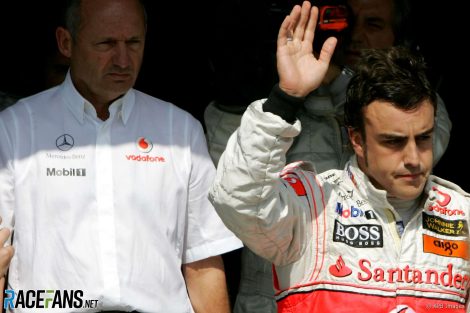
But Alonso found himself at the centre of an acrimonious dispute with the McLaren team with opinion divided over whether he was the instigator or the victim.
There were signs early in the season that Alonso was unhappy with the rookie Hamilton’s early run of success. He became increasingly vocal with his demands that the team concentrate on backing his title bid, even as Hamilton took the lead of the championship.
Relations within the team broke down completely at the Hungarian Grand Prix. Hamilton refused an instruction from the team to allow Alonso past during qualifying, so Alonso retaliated by delaying Hamilton in the pits, preventing his team mate from setting a final lap time.
The stewards punished Alonso for baulking Hamilton and McLaren for failing to provide an adequate explanation of what happened.
During the course of the season McLaren had defended itself against allegations that it had obtained confidential information about Ferrari’s car. Team principal Ron Dennis claimed that on the morning of the Hungarian race Alonso threatened to expose compromising information about the alleged espionage of Dennis did not rein Hamilton in.
McLaren persisted with its policy of giving both drivers equal treatment and Alonso alienated himself further from the team, increasing his public complaints about their operation.
At the final round, at the request of the Spanish racing authority, an independent adjudicator was stationed in the McLaren pit during qualifying to ensure there was no foul play. He found none.
Alonso and Hamilton unable to keep Raikkonen from clinching the title in the final race. Shortly after the season ended McLaren terminated their contract with Alonso and he returned to Renault for 2008.
Renault
2008
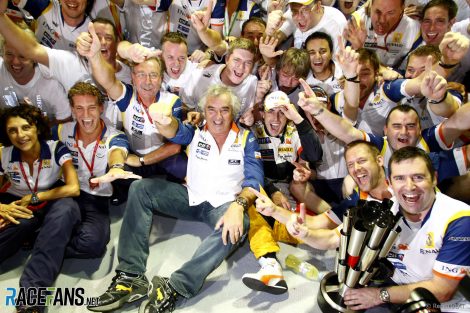
The Renault Alonso returned to in 2008 was not the team he left two years earlier. The R28 was off the pace, and in the first half of the season it was all Alonso could do to get it into the points. After seven races he’d scored just nine.
A string of aerodynamic developments helped bring the R28 back on terms with the front runners in the second half of the season.
But some members of the team felt they needed more than performance to win races, and at Singapore Alonso’s team mate Nelson Piquet Jnr was unconscionably ordered to crash his car on purpose to help Alonso win the race.
The plan worked, but in the very next race at Fuji Alonso won on merit. He out-ran BMW’s Robert Kubica, and a strong second in the season finale brought him up to fifth in the drivers’ championship.
Advert | Become a RaceFans supporter and
2009
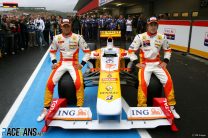
He remained at Renault for 2009, but the R29 proved even less competitive than its predecessor and it took until the 14th round at Singapore for Alonso to even get on the podium.
Coincidentally, it was the first weekend after Briatore and engineering director Pat Symonds had left F1 in disgrace after the conspiracy of the previous year was exposed. The FIA’s World Motor Sports Council determined Alonso had not known about the plan.
Shortly after that exoneration Ferrari finally confirmed the long-standing suspicions that Alonso would join the team for 2010, alongside Massa.
Ferrari
2010
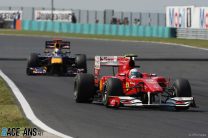
Alonso got his Ferrari career off to a perfect start with victory in his first race for the team at Bahrain. But his championship prospect were stymied by a series of problems including a jump start at China, a penalty at Silverstone, a crash during practice at Monaco and some reliability problems.
He came roaring back in the second half of the season following a controversial victory in Germany, where Massa was ordered to let him win, contravening the FIA’s ban on team orders. Alonso added further victories in Italy, Singapore and Korea to lead the championship heading into the final race.
But a potential third world championship slipped through his fingers after a tactical error by the team at Abu Dhabi. Sebastian Vettel grabbed the title at the final round while Alonso spent most of the race stuck behind Vitaly Petrov, one of his successors at Renault.
2011
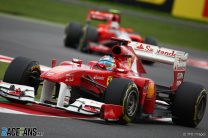
After the disappointment of losing the title came another blow: the new 150° Italia wasn’t quick enough to challenge for the championship in 2011. Alonso won just once, at Silverstone, after a change in the rules temporarily restricted the use of exhaust-blown diffusers, something Ferrari had struggled to master.
Alonso continued to operate at the peak of his considerable abilities, finishing on the podium ten times while Massa never made it as far as fourth place.
He ended the year fourth in the championship, but was helpless to prevent Vettel succeeding him as the youngest twice-champion. Despite the setback Alonso pledged his future to Ferrari until 2016.
2012
For the third time in six seasons Alonso came close to the championship but feel short but a handful of points in 2012.
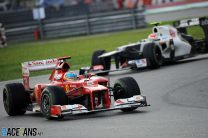
This had not looked likely early in the season when Ferrari’s new F2012 proved woefully of the pace. But even before the team found a major step in its performance Alonso had already won in the rain in Malaysia.
Further opportunistic wins in Valencia and at the Hockenheimring put him in the lead of the drivers’ championship. But Alonso could do little to resist Vettel late in the season, particularly after first-lap retirements in Belgium and Japan.
Even so he remained in the hunt until the final race, where he finished ahead if Vettel on the track but couldn’t do enough to win the title.
2013
Alonso was runner-up for the third time in four years in 2013. The season had begun promisingly: he finished ahead of Vettel in Australia, then won in China and, for a third time, at home in Spain.
But as the summer break neared Ferrari were grappling with a familiar problem. The updates they were bringing for the F138 did not provide the anticipated gain in performance.
Alonso’s frustration told at times. There were rumours his management made approaches to other teams and in Italy he berated his team on the radio after an attempt to use Massa to give him a tow on the straight during qualifying did not go according to plan.
But he was reliably in contention for podium positions and secured second in the championship before the end of the year.
2014
Alonso had experienced the disappointment of two championship near-misses at Ferrari, but in 2014 he suffered the pain of never being in the fight. It was clear from the first round of the season that the F14 T was never going to compete in the first year for F1’s new V6 hybrid turbo engines.
That realisation led to upheaval at Ferrari, and following an especially excruciating performance at the third race of the year in Bahrain team principal Stefano Domenicali tendered his resignation. He followed over the course of the year by several of the teams top technical staff.
And, eventually, Alonso too. He toiled all year long in the car, attaining considerably better results than new team mate Raikkonen. But the best he could manage was a pair of podiums in China and Hungary.
Seeking to align himself with a new manufacturer, Alonso took an extraordinary decision to return to McLaren, where he had departed on bad terms just seven years earlier. McLaren had lured Honda back to F1 with the goal of developing a power unit which would defeat F1’s new standard-setters, Mercedes.
Advert | Become a RaceFans supporter and
McLaren
2015
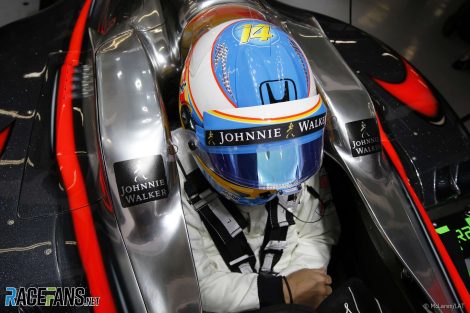
It’s unlikely Alonso was labouring under any illusions over how difficult McLaren’s first season with Honda would be. A year of unrelenting frustration began before the first race.
The team were grappling with numerous reliability problems in testing when Alonso crashed in mysterious circumstances at the Circuit de Catalunya. He suffered concussion, and doctors later ruled he should miss the opening race of the season as a precaution.
Alonso was back in the car in Malaysia but would have been forgiven for wondering whether he should have bothered. It took him until the ninth race of the season to get any points on the board.
With Honda’s engine providing as much as 200bhp less than the front-running cars enjoyed, he made his dissatisfaction plain as other drivers passed him with ease while his race engineer urged him to save fuel. In the Japanese Grand Prix at Suzuka, Honda’s home track and race, Alonso gave his strongest indictment of the power unit, repeatedly complaining on the radio about his “GP2 engine”.
There were occasional moments of relief. In Hungary, where the tight track layout lessened the disadvantage of Honda’s engine, Alonso delivered a fifth place finish which must have felt like a race victory. But this second visit to the points was also his last of a largely futile campaign.
2016
For the second season running Alonso found himself sidelined early in the campaign. This time he made it to Melbourne but crashed heavily in the race when he tangled with Esteban Gutierrez. Concerns over his condition kept him out of round two in Bahrain.
Once he got back into the car improvement came slowly but surely for the Honda-powered package. Driving with his usual verve, Alonso peaked with fifth place in Monaco (leading one of the Mercedes at the flag) and and again at the Circuit of the Americas, elbowing Massa aside with a bold late pass.
Whatever the shortcomings of his car, Alonso was more concerned about the overall direction of the sport. As he entered the third year of his McLaren contract he again let it be known that he would race elsewhere unless Formula One returned to being more about outright performance than fuel and tyre preservation.
2017
Hopes of further gains in 2017 were dashed quickly, and McLaren announced before the end of the season they would part ways with Honda.
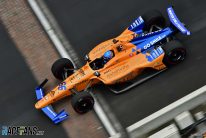
Alonso failed to register a finish until the fifth race of the season, in Spain, where he came in 12th. By then he had already decided to ply his trade elsewhere: Earlier in the year he announced plans to race a McLaren-backed, Andretti-run car in the Indianapolis 500.
His Stateside venture went well: He led 27 laps and was in the hunt for victory when his engine – also a Honda – let go 21 laps from home. Team mate Takuma Sato won.
Back in F1, Alonso could do little more than mark time until the season ran its course. He picked up a handy sixth in Hungary and finished the last three races in the points, but such slim pickings in the team’s third season with Honda was not what he or McLaren had signed up for.
2018
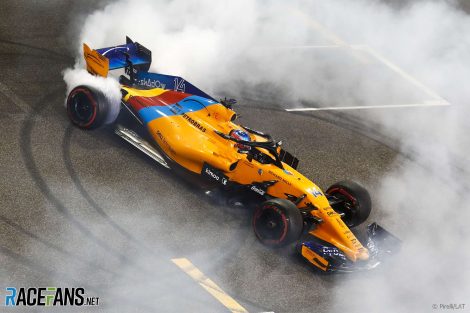
Nonetheless Alonso mustered regular points finishes over the opening phase of the season. But from seventh in the championship after the first five races, he was down to eighth after 10. He made just two more visits to the points over the remainder of the season, and fell to 11th. He did, however, never fail to out-qualify team mate Stoffel Vandoorne.
He also continued his extra-curricular activities, racing for Toyota in the World Endurance Championship. Alonso shared victory for them in the Le Mans with team mates Sebastien Buemi and Kazuki Nakajima.
The trio won five races out of eight in the 2018-19 season, including delivering Toyota a long-awaited first Le Mans 24 Hours win by two laps in 2018 then doing it again in the season finale a year later. With the trophies stacking up in sports cars but not in F1, Alonso decided to focus on the former and announced his retirement from F1 at the end of the 2018 season.
Advert | Become a RaceFans supporter and
Retirement
Heading into 2019, he began the year by winning the Daytona 24 Hours. He did make one single-seater outing, as he returned to the Indy 500 with McLaren, but he did not actually make it to race day. After a week of electrical issues, team errors and a crash, his IndyCar return was capped off with not being fast enough to qualify for the race.Alonso started 2020 by competing in the Dakar Rally for Toyota, finishing an impressive second on one stage and coming home 13th overall in the car class of the iconic rally-raid, then returned to the Indy 500 again Alonso also drove for the United Autosports team owned by McLaren CEO Zak Brown in the Daytona 24 Hours with McLaren junior Lando Norris as his team mate.
After competing in the Dakar Rally, Alonso made a third appearance at Indianapolis during the pandemic-disrupted 2020 season, as a third driver in addition to McLaren’s regular line-up of Pato O’Ward and Oliver Askew. With no threat of non-qualification on this occasion, Alonso lined up 26th on the grid behind his team mates and scored his first finish in the race in 21st place.
Alpine
2021
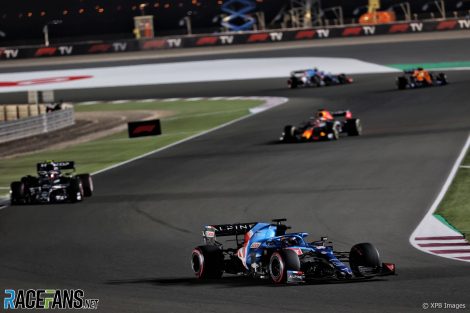
Having tested regularly for the team late in 2020, Alonso’s preparations suffered a blow in February 2021 when he was involved in a road accident while cycling. He still managed to make it to the opening race, qualifying ninth but then retiring with brake issues.
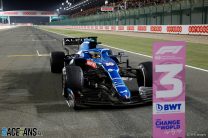
Alonso was more often than not in the points thereon, scoring 13 times in 19 races and with a best finish of fourth at the Hungaroring. He went one better than that as the season reached its end, starting and finishing third in the inaugural Qatar Grand Prix at Losail.
With 81 points and an end result of 10th in the standings, it was Alonso’s most competitive year in F1 since 2014.
2022
Alonso matched that points haul exactly in his second season with Alpine, and although there were no podiums it was a more impressive season for the team as Alonso finished ninth in the points table and the team rose to fourth in the constructors’ standings.
In the middle of the season Alonso went on a run of ten consecutive races in the points, a feat only the top three in the championship also managed and something Alonso last achieved in 2014.
But Alpine’s improving form, which Alonso made use of to finish fifth at Silverstone, Spa and Interlagos, wasn’t enough to convince him the team was on a trajectory to take him back to race-winning success and he signed to join Aston Martin for 2023 almost immediately after a vacancy appeared at the team.
Fernando Alonso pictures
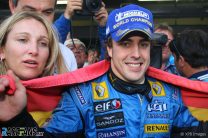


Fernando Alonso links
Featured articles
- Youngest-ever champion Alonso crowned
- Third title eludes Alonso in first year with Ferrari
- Fernando Alonso’s route to F1
All articles
- Alonso and Hamilton used unconventional strategies, but one worked better
- Vote for your 2024 Chinese Grand Prix Driver of the Weekend
- Alonso “nearly lost the car” on lap that secured third on grid
- Alonso handed 10-second penalty for Sainz clash despite retiring from sprint race
- Alonso says he needs Stroll’s help to get “100%” from Aston Martin’s car