






How does Red Bull get away with all the transgressions?
- This topic has 73 replies, 19 voices, and was last updated 11 years, 5 months ago by
raymondu999.

- AuthorPosts
- 29th October 2012, 19:11 at 7:11 pm #132298
Michael
ParticipantJust at the last race in India, Vettel put 4 wheels out of the track during qualifying and then there was talk about some part wearing down by more than 1 millimeter. Apparently, the steward in India thought that he didn’t gain an advantage and therefore he felt that the violation didn’t warrant a penalty.
At the beginning of the season, they had other issues. On the track Vettel has his own rulebook that the FIA keeps just for him and it’s 1 page long with the name Vettel on it.
I’m curious – how does a team secure this type of special treatment?
29th October 2012, 19:15 at 7:15 pm #214058 Fer no.65Participant
Mind listing those “Vettel rulebook” incidents?
I can’t think of any. And I think you’re overreacting… winning teams are always controversial, for one thing or another. But I don’t buy the “own rulebook” argument.
29th October 2012, 19:19 at 7:19 pm #214059Kingshark
ParticipantHere are various examples of Vettel cutting the track in qualifying to gain an advantage, and no, the curbs aren’t a part of the circuit itself. Disappointed, I am.
29th October 2012, 19:28 at 7:28 pm #214060ParticipantWell, here are some examples I can think of:
1. Putting 4 wheels off at India
2. Blocking Fernando at Suzuka in qualifying
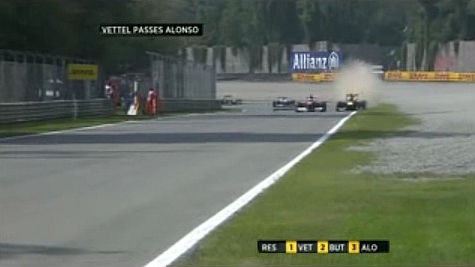
3. Passing Alonso at Monza 2011 (not sure about this one – were all 4 wheels off?)
4. Pushing Button off the track at the start of a race in 2011To give a comparison, Lewis put 4 wheels off while qualifying at Hungary in 2012 and he scrapped the lap as he knew they would never count it (in his case). Why would Vettel ever think they’d count his lap?
If Lewis had done 3 & 4, guaranteed drive-through penalties.
29th October 2012, 19:30 at 7:30 pm #214061Participant@kingshark – Doesn’t going off track automatically give an advantage as you can carry more speed out the corner? Obviously Webber deserved pole in India especially since Red Bull put him right in front of a McLaren to limit him to 1 lap.
29th October 2012, 19:40 at 7:40 pm #214062Mads
Participant@freelittlebirds
3. Passing Alonso at Monza 2011 (not sure about this one – were all 4 wheels off?)
First of all, no he only had two wheels off the track. Secondly, regarding you “Lewis is penalized for everything!” statement, remember Bahrain this year? he overtook Rosberg with all four wheels off the track, but wasn’t penalized.Regarding his pole lap in India, then you will have to look at all the other qualifying laps, because I have a suspicion that a lot of other peoples did exactly the same.
In which case it would be like in Monza at the exit of Ascari where drivers can leave the track completely but the stewards and the drivers have agreed that its fine.29th October 2012, 19:51 at 7:51 pm #214063 Force MaikelParticipant
I have taken a good look at his India pole lap and I counted 4 moments where he put 4 wheels outside the track. I can narrow it down to 3 because it has been accepted that you can run wide after turn 11. I’ve also taken a good look at other people’s laps and they don’t do it. we could be onto something interesting here.
Just to be clear: Article 20.2 in the FIA Formula One Sporting Regulations 2012. The kerbs are NOT considered to be part of the track. You may leave the track and rejoin if you don’t gain ANY advantage.
29th October 2012, 19:51 at 7:51 pm #214064mnmracer
ParticipantButton told BBC it was agreed in the driver’s briefing they could take the curbs there.
6 of the Q3 onboards show drivers doing this.29th October 2012, 20:00 at 8:00 pm #214065Participant@Mads
If I recall correctly, the stewards couldn’t penalize Lewis in Bahrain without appearing to be completely biased as Rosberg had done the same to Alonso or another driver. Plus wasn’t Rosberg in violation of not leaving any room for Lewis so the transgression was a consequence of Rosberg’s illegal defending? The stewards can’t penalize a driver for a mistake caused by another driver’s mistake.I think we would know by now whether other drivers had also put 4 wheels off the track – those things don’t stay quiet.
29th October 2012, 20:39 at 8:39 pm #214066 JPQuesadoParticipant
If the kerbs are not considered part of the track, then FIA have to tell Tilke to make them narrower! They are more than a car’s width, it’s impossible to make drivers not use them to their advantage!
29th October 2012, 21:18 at 9:18 pm #214067Fer no.65ParticipantBlame the FIA for letting those idiots in the design department at Tilke’s company build circuits that ALLOW that sort of thing.
What’s the point of a kerb, that has it’s own kerb that’s higher and doesn’t penalizes you?. Why use tarmac instead of grass, right at the side of the racetrack?
Have you seen anyone going wide at Variante della Roggia to try and gain an advantage? or Lesmo? And I don’t see any more risk having gravel traps instead of tarmac. If all the circuits were designed like Abu Dhabi, Suzuka’s esses would be almost straight on. Don’t blame the drivers for using parts of the tracks that benefit them.
That 4 point list isn’t that long, nor it means that FIA treats Vettel in any way different than others. They are constantly making mistakes with every driver. Be it Hamilton, Maldonado or Alonso.
29th October 2012, 22:22 at 10:22 pm #214068katederby
ParticipantGoing off topic, slightly but I think Vettel has had two reprimands , what were they for? Another will give him a grid penalty, which could be interesting.
29th October 2012, 22:34 at 10:34 pm #214069Participant@Force Maikel
Thanks for putting the regulation.
Just curious, do drivers NOT gain an advantage when 4 wheels are off the track around a corner where they keep full control of the car?
Is it likely that a driver can get Pole position and NOT have gained an advantage by doing so? Obviously if he had lost an advantage, he would have not gotten pole… but that type of logical thinking can be very dangerous:-)
29th October 2012, 23:20 at 11:20 pm #214070 David-AParticipant
At Monza 2011, 2 wheels were clearly on the track.
At Suzuka 2012, I don’t really see what else Vettel should have done. He appears to go wide at the chicane to give the Ferrari room. I don’t even think he should have been reprimanded.
29th October 2012, 23:42 at 11:42 pm #214071raymondu999
ParticipantYes the issue at Suzuka is that the track there is narrow, and he would have been counted as blocking whatever happened, unless he took to the grass.
What we don’t see are the rear wheels in corner cutting. We see the fronts leave the circuit, but not when the rears do it. If the front tyres rejoin the circuit before the rear tyres leave the circuit, the manoeuvre is legal
What the stewards look for is different lines. If every driver does it then they turn a blind eye.
We need to remember that the teams police each other. If they felt a penalty was on THEY would have complained.
- AuthorPosts



- You must be logged in to reply to this topic.