



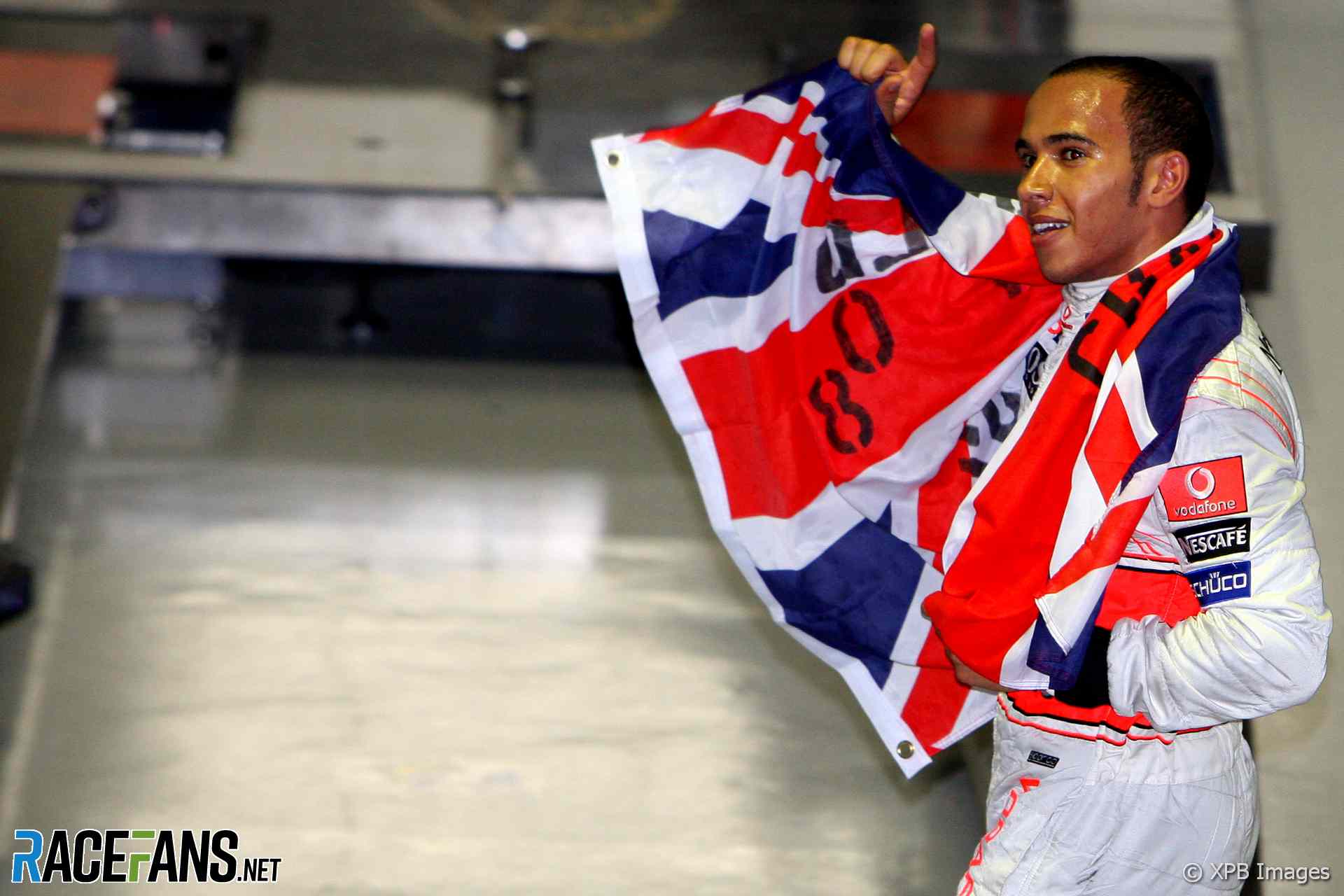
Lewis Hamiltonhas become the first McLaren driver to claim the world championship since Mika Hakkinen nine years ago. With that in mind, Lustigson suggested an article looking at the longest droughts suffered by championship-winning teams.
Ferrari went 21 years between drivers’ champions from 1979 (Jody Scheckter) to 2000 (Michael Schumacher) – and that’s not the Tifosi have waited over a decade for a drivers’ title. McLaren, Brabham and Benetton (now Renault) have also seen long title droughts. Here’s how they lost and re-discovered their form.
If it seems odd to think of a ‘title drought’ in terms of how long it takes a team to make a driver world champion, it’s merely a reflection of the lack of importance placed on the constructors’ championship compared to the drivers’ championship by most people. For example, at the end of 1999 there was more talk of Ferrari going two decades without a drivers’ title than them ending their 16-year wait for a constructors’ championship.
Here are five of the longest droughts – plus a once-great team currently enduring its longest ever wait for a new champion…
Ferrari, 1964-1975
When the Formula 1 regulations changed early in the 1960s to reduce engine size to 1.5 litres, Ferrari were the team that reacted best. Phil Hill drove the gorgeous Ferrari 156 to the championship in 1961, the first year run to the new rules. and three years later John Surtees claimed another title for the Scuderia.
That title was won despite resources bring split between its Grand Prix and sports car programmes. This was one of an increasing number of differences between Surtees and team manager Eugenio Dragoni, which eventually led to Surtees leaving the team and, a few years later, Dragoni being cast out. Lorenzo Bandini succeeded Surtees as team leader, but the young Italian was killed at Monaco in 1967.
This was the same year Ferrari’s opposition took a leap ahead after the introduction of the Cosworth DFV V8 engine by Lotus. Graham Hill won the championship with it in 1968 and the same engine powered the next seven world champions.
By 1975 Ferrari had a fresh new look, with the young Luca di Montezemolo running the team and Niki Lauda driving the Mauto Forghieri-designed 312T. Lauda took five wins in a closely-fought season to claim Ferrari’s first drivers’ title in over a decade.
Brabham, 1967-1981
The Brabham team that Denny Hulme won the 1967 world title for was very different to the one that Nelson Piquet won the 1981 drivers’ championship with.
In 1967 Hulme’s team mate was also his boss – Jack Brabham. Hulme wondered if that meant Brabham sometimes kept a few of his innovations secret, Nonetheless, Hulme claimed the title by five points from ‘Black Jack’.
Five years later Bernie Ecclestone bought the team and in 1973 made Gordon Murray chief designer. Murray’s work was touched by genius: sometimes devastatingly effective, sometimes fundamentally flawed, but always radical and original. Paired with Nelson Piquet the team struck gold in the early eighties, as Piquet snatched the 1981 title from Carlos Reutemann at the final round. A second title with BMW turbo power followed in 1983, but it was Brabham’s last.
Ferrari, 1979-2000
The longest and surely the most famous F1 victory drought.
The 312T4 that Jody Scheckter drove for most of his title-winning 1979 campaign must stand out as one of the ugliest cars to win a world championship, though it is likely to be surpassed by whatever wins the 2009 title. Ugly and fast is fine, but its successor was ugly and slow, and that was no good at all – Scheckter even failed to qualify for one race.
Ferrari were one of the first teams to follow Renault’s lead in developing turbocharged 1.5-litre F1 engines and might have capitalised on that early switch in 1982. But first Villeneuve was killed at Zolder and then Didier Pironi suffered appalling injuries at Hockenheim; Ferrari won the constructors’ championship but not the drivers’ title, and repeated the result in 1983.
After a series of increasingly fallow years for his team, patriarch Enzo Ferrari passed away in 1988, a year when his cars and everyone else’s were routed by McLaren. But the next year John Barnard’s 640 introduced semi-automatic gearboxes to F1 and seemed set to take the team back on the road to the front. Alain Prost was recruited and took on Ayrton Senna for the 1990 title – but lost out to his arch nemesis.
The team lapsed into another of its periods of un-competitiveness and internal acrimony. Prost was thrown out of the team and three years passed without a race win. But the appointment of Jean Todt as team principal in 1993 was the beginning of a series of changes which, seven years later, finally delivered a drivers’ championship.
Tost’s most significant hiring was Michael Schumacher, who joined in 1996, and was followed by Benetton cohort Ross Brawn the following year. A succession of tantalising championship near-misses followed: Schumacher lost out to Jacques Villeneuve in 1997, then Mika Hakkinen in 1998. In 1999 Schumacher was injured and Eddie Irvine took up to fight but he too failed to defeat Hakkinen.
Finally in 2000 it came good and now the floodgates opened: Schumacher stormed to an unprecedented five consecutive world championships.
Benetton / Renault, 1995-2005
The Team Formerly Known As Toleman became Benetton in 1986 and won its first Grand Prix that year. Eight years later the Schumacher-Brawn collaboration that would prove so devastating at Ferrari delivered its first championship, and they doubled up in 1995.
With Schumacher gone in 1996 the team suffered instantly: no wins. In fact, from 1996 until its takeover by Renault at the end of 2001, the team scored just a single victory. The man who ended its win drought in 2003 would also win its first post-Schumacher world championship two years later: Fernando Alonso.
Like Schumacher, Alonso was talent-spotted by Flavio Briatore. In 2005, ten years since Schumacher last won a title for the team, Alonso became world champion. Continuing the Schumacher theme, Alonso won another title the next year, then quit to join a rival outfit.
McLaren, 1999-2008
While Ferrari, Brabham and Renault in the examples above all went through uncompetitive periods amid long gaps between titles, McLaren won at least one race every year between Mika Hakkinen’s championship in 1999, and Lewis Hamilton’s this year, apart from in 2006.
Part of McLaren’s problem was the aggressive design concept it began following in 2003, which led to the construction of the un-raced MP4/18A. That spawned the MP4/19 the following year which was slow and disastrously unreliable, but even then after a late-season upgrade it became a race winner.
The MP4/20 was the fastest car of 2005, but too unreliable, and for the fourth time in six years a McLaren driver was runner-up in the drivers’ championship.
The team were very competitive in 2007 but after in-fighting between Alonso and Hamilton and the damaging distraction of the spygate inquiry the team ended the year with both its drivers one point behind world champion Kimi Raikkonen. Finally, Hamilton broke the team’s championship losing streak this year.
Read more: Lewis Hamilton wins the 2008 F1 title and becomes youngest world champion
Williams, 1997-?
Jacques Villeneuve’s world championship victory for Williams was the end of an era. Engine supplier Renault left the team at the end of the year. Designer Adrian Newey had already shipped out, meaning the 1998 FW20 was designed without him. They even switched from the classic blue Rothmans colour scheme to Winfield red, which on a Williams looked plain wrong. At the end of 1998 Villeneuve and team mate Heinz Harald Frentzen had gone too.
If that was the end of the one era, when will Williams’ era of championship defeat end? Wheir partnership with BMW began fruitfully with a podium at their first race together in 2000 the future looked bright. Five season later a frustrated Mario Theissen severed BMW’s deal with Williams and took over the Sauber team, where they have enjoyed conspicuously greater success over the past three years than their former partners.
Williams haven’t won a race since 2004, and next year the cars will have numbers 16 and 17 on them, which says everything you need to know about how well this season went.
Will Williams’ title drought ever end?
Read more: BMW’s win vindicates split from Williams

MrPippy
29th November 2008, 9:30
The MP4/20 was the fastest car of
20002005.Keith Collantine (@keithcollantine)
29th November 2008, 11:08
Indeed it was – fixed!
ceedas
29th November 2008, 13:37
I doubt that Williams’ win drought will end if they remain in their current form. They’re one of only a few privateer teams left, no dissimilar to Force India, yet with their history we tend to expect much more in terms of results.
For Williams to return to winning ways, there need to be huge changes in the regulations of the sport, or perhaps in the management of the team.
the limit
29th November 2008, 15:38
I seriously doubt Williams can end their eleven year championship winning drought, purely because they are so limited in their resources now.
During the Montoya year of 2001-2004 with the BMW engines, it appeared that Williams were mounting a comeback. Infact, in 2003, they came within one bad stewards decision of challenging for the title.
However, as much as I respect Frank Williams and Patrick Head’s decision to go to Toyota engines, I believe they would have been better served doing what Peter Sauber did and selling to BMW.
Don’t get me wrong, I hate seeing the private teams go. Formula One is a lesser series without the likes of Jordan, Brabham, and Williams, but we live in a different world now.
In the USA, teams are merging together to compete with the big boys or risk facing the chopping block, and the current credit crunch is the last thing they need. They are brave people Williams, but I am very fearfull for their future, even to exist.
Tim
29th November 2008, 16:01
I’m not sure Williams will be able to break out of their current cycle, which would be a shame for a team that’s won titles with names as evocative as Rosberg, Piquet, Mansell, Prost, Hill and Villeneuve.
Ferrari, McLaren and Benetton/Renault all endured long periods without winning titles but were generally always well funded and generally had a works engine deal. The latter is pretty much a fundamental component for success these days. The last team to win a title without a manufacturer engine deal was McLaren back in 1986 with its self-funded, Porsche designed, TAG-badged unit. Before that it was Keke Rosberg in a Williams-Cosworth in 1982.
I suspect Williams’ downfall is as much to do with what makes it such an easy team to love. It’s an no nonsense, old fashioned racing team, not as corporate or as slick (as an organisation) as McLaren. Frank Williams wasn’t as willing as other team principals to effectively merge with a car manufacturer and that ultimately cost the team its BMW deal.
In the current climate there don’t appear to be many manufacturers waiting to enter F1 with an engine supply deal. Even if there were, Red Bull probably offers a more promising option.
GeorgeK
30th November 2008, 7:19
Nice article Keith and my conclusions concerning Williams is in the same vein as your other readers. The technology and cubic dollars required to compete has kept them out of the championship hunt.
Will the new formula help or hurt them? Or will Frank and Patrick ultimately go the way of Force India and wind up “merging” with Toyota or possibly another manufacturer. Maybe back to BMW? I really thought that Toro Rosso would get bought by Ferrari in keeping up with McLaren’s new foray with Force India.
PJA
30th November 2008, 9:17
Sadly I agree with all the previous comments regarding Williams. I think it is more likely that Williams will go the way of Lotus than win another title. I cannot see any privateer team winning a title, and I doubt a manufacturer would enter Formula 1 in the current economic climate.
Lustigson
1st December 2008, 7:59
Great article, Keith. I hadn’t really thought of Williams’ 11-year drought when I posted on Skribit, though.
DG
1st December 2008, 8:25
Thank you Keith for an article to remind the younger and more forgetful fans that F1 has had a long history, and that teams such as Ferrari and McLaren have not always been as dominant as they are now.
Phil B
2nd December 2008, 10:50
I too think it’s a shame about Williams but can’t see how they can turn it around without selling all or part of themselves to a car manufacturer.
If the FIA are serious about cost cutting then I can only see one viable option. Forget standard engines, frozen engines, all that rubbish. The FIA need to insist that the teams are not owned, in any way, by non-F1 companies. They would have to be owned by the team principles, the employees etc, just like in years gone by. The car companies would have to sell their stakes back to the teams, probably at a loss. They would still be able to supply engines, at a cost, and sponsor as many teams as they like but not own any of them. It would be a return to the old form of F1. Yes there would be all manner of messy untangling as the car manufacturers lose out on their investments but the sport would be safe and would prosper. Ultimately the car manufacturers would spend less (its harder to justify monster expenses on advertising and engine supply than ‘partnership’ etc) and the teams would be free to race as of old.
It would then be in the interests of each engine supplier to supply as many teams as possible, to increase the chances of winning, thereby keeping the price of engines down.
It would also preserve the role of Williams because everyone would effectively be following their model once again. And it would again make F1 attractive to newcomers.
Keith Collantine (@keithcollantine)
2nd December 2008, 15:27
DG – You’re welcome! It’s hard to imagine Ferrari going three races without winning a Grand Prix now, never mind three years…
Rabi Sultan
3rd December 2008, 4:53
Would be interesting to see if the future can bring more teams to F1 as that is the one possible item that could save Williams. More teams in means more potential customers who could possibly buy products from Williams.